Author Archives: terriflorentino

Dusty, Part 1

How I Met Your Puppy

by Terri Florentino

“Our dog didn’t get the memo.” The man sat at the head of the dining room table, and the woman, having brought me a glass of water and placed a coaster on the table in front of me, sat herself across from me, both of them agitated. I sipped my water, set the glass on the coaster, and glanced at the cutie behind the baby gate, the cause of all this distress.

DustyPuppyThere sat the most adorable off-white young dog, his entire body a tumble of touchable, soft, little curls. For a young dog, barely fifteen months old, he sat strangely still, almost like a stuffed toy the kids had left behind. He was unnaturally expressionless, not even wiggling his tail. He just sat stiff and observed, as if miffed that things had come to this.

“What memo?” I said.

“The one that says a dog is man’s best friend.” The frustration in Robert’s voice was unmistakable.

“Tell me what happened.”

“I headed to bed where Dusty was sleeping next to Susan,” he said. “He always refuses to move out of my way when I try to get into bed, but this was the worst—he attacked me!”

Eyes filling with tears, Susan picked up the story with terror in her voice. “Dusty attacked. He tore Rob’s pajamas. He lunged at him again and again, biting him on his hips and arms.” Susan’s arms flailed as she described the trauma. “I flew out of bed, grabbed a pillow, and forced it between them. Dusty started tearing apart the pillow. He was like Cujo! He was savage! We couldn’t stop him!” She cried openly now. “Feathers were flying everywhere! I reached around the pillow, grabbed Dusty’s collar, and dragged towards the bathroom. He kept snarling and jumping at Robert.

Once I got him alone in the bathroom with me, he calmed down. I let him go, and he looked up at me as if to say, ‘Aren’t you proud of me?’ I was a wreck!” She wiped her eyes with her fingertips. “Who’m I kidding? I’m still a wreck.”

I glanced at the cute, curly-haired pup. Throughout the entire account of the violence he’d perpetrated, he just sat quietly, as if listening intently and agreeing, “Yes, that’s exactly how it happened, but as soon as you hear my side, you’ll understand my actions were perfectly justifiable.”

“Once he was settled,” Susan said, “I slipped out to get his leash, came back, and clipped it to his collar.”

“Good thing, too,” Rob said. “As soon as he saw me, he lunged at me again, growling like a mad dog. I swear to you, I’ve never laid a hand on this animal. I mean, look how cute he is. I’ve only been kind to him.”

Dusty just blinked behind his curls and licked his button nose.

Susan sighed, emotionally exhausted. “Can you help us, Terri?”

“I’ll do my best. We have a lot of work to do. Tell me where Dusty came from.”

“You sure you don’t want anything to eat?” Rob asked.

“No, thanks.” I heard children at play upstairs, and I wondered how Dusty had lasted this long. “Where did you get him?”

“My sister had the most lovable cockapoo,” Susan said, “which is why I chose this breed. I had no idea that not all cockapoos were created equal.” She’d done her research and found what she believed to be a responsible breeder on the Internet. She had to submit an on-line application. The breeder accepted, and Susan sent in a nonrefundable deposit.
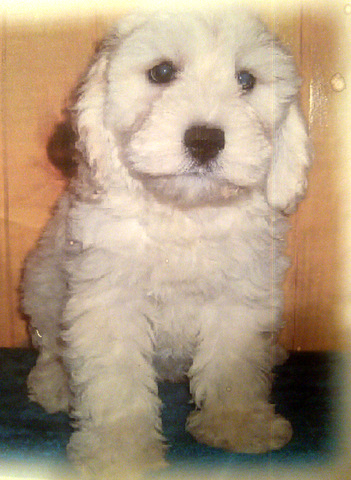
The picture sent by the breeder.

Susan fell in love with the little guy in this picture.

“She let me choose my puppy based on a picture. I suppose that should have been my first red flag. She guaranteed her pups would have wonderful dispositions, and I trusted her.” Susan let out another sigh, Rob shook his head, and Dusty, behind his baby gate, slid down onto his elbows with a thump.

“Out of the blue, the breeder even sweetened the deal by putting my puppy on sale, dropping the price from a thousand to eight hundred dollars, the second red flag. She said she’d been ill and had too many puppies; she needed to move them quickly. That was red flag number three.”

Early on a Friday morning in 2007, Susan along with her young school-age daughter, Sarah, set out on their ten-hour, round-trip journey to pick up the family’s adorable new puppy. The weather was beautiful. Sarah was so excited, she had even passed up a chance to join her classmates on a school trip to the local amusement park.

“What should we name him?” Sarah said. “We still don’t have a name!”

“Why don’t we wait until we get him home to decide? This should be a family decision.”

“I can’t wait! I want to hold him and love him and kiss his little puppy nose.”

“You shouldn’t kiss his little puppy nose. He might have germs.”

“Cockapoos are too cute to have germs. The germs just bounce right off.”

As they neared their destination, they drove through a charming little farm community outside of Pittsburgh. They came upon a sign at the end of a driveway: “Professional Cockapoo Breeder.” They drove down the long driveway to a nice home with a well manicured lawn. As soon as they parked, Sarah and Susan jumped out of the car, eager to meet their furry new family member.

A young woman came outside to meet them. Susan was surprised; the woman with whom she’d been exchanging emails had seemed older. The young woman held out her hand and said, “I’m her daughter. My mother’s sorry she’s not available to meet with you.” She turned to Sarah. “Are you ready to see your puppy?”

“Yes, yes, yes!” Sarah said and jumped up and down.

“Okay, then. Great. Follow me.” And she led them inside.
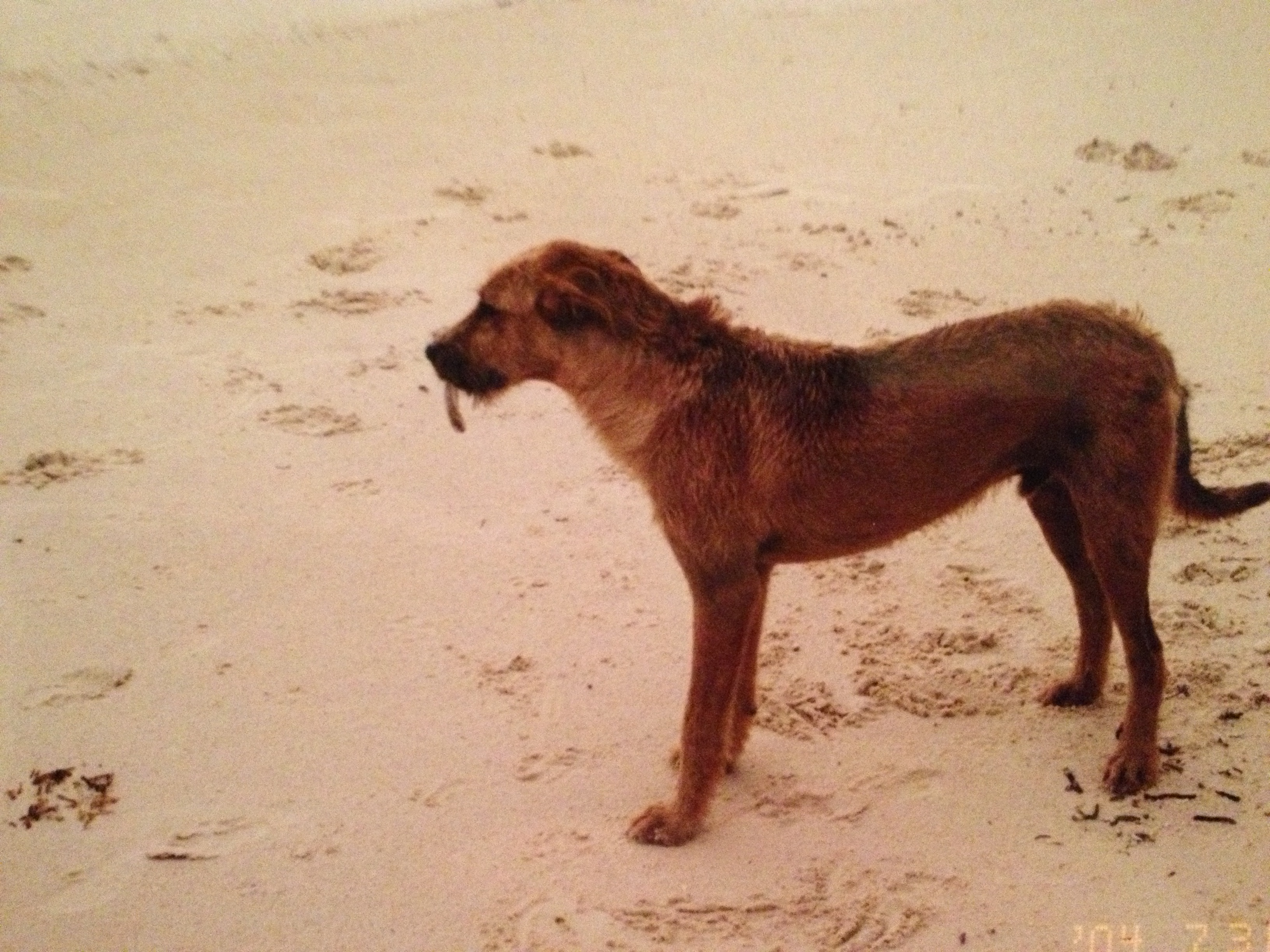
Meet the Royal Bahamian Potcake

Our Potcake

by Kristin Strong

On August, 2004 we arrived in Nassau, Bahamas for a much-needed vacation. Once we completed checking into our hotel, we took our first walk on beautiful Cable Beach. While walking John and I saw a couple of dogs roaming around the resort. They appeared unwell and malnourished. I later learned that the Bahamian people viewed these feral dogs as a nuisance. They would shoot or poison them. They feared their presence would drive away the tourists that provided their livelihood.

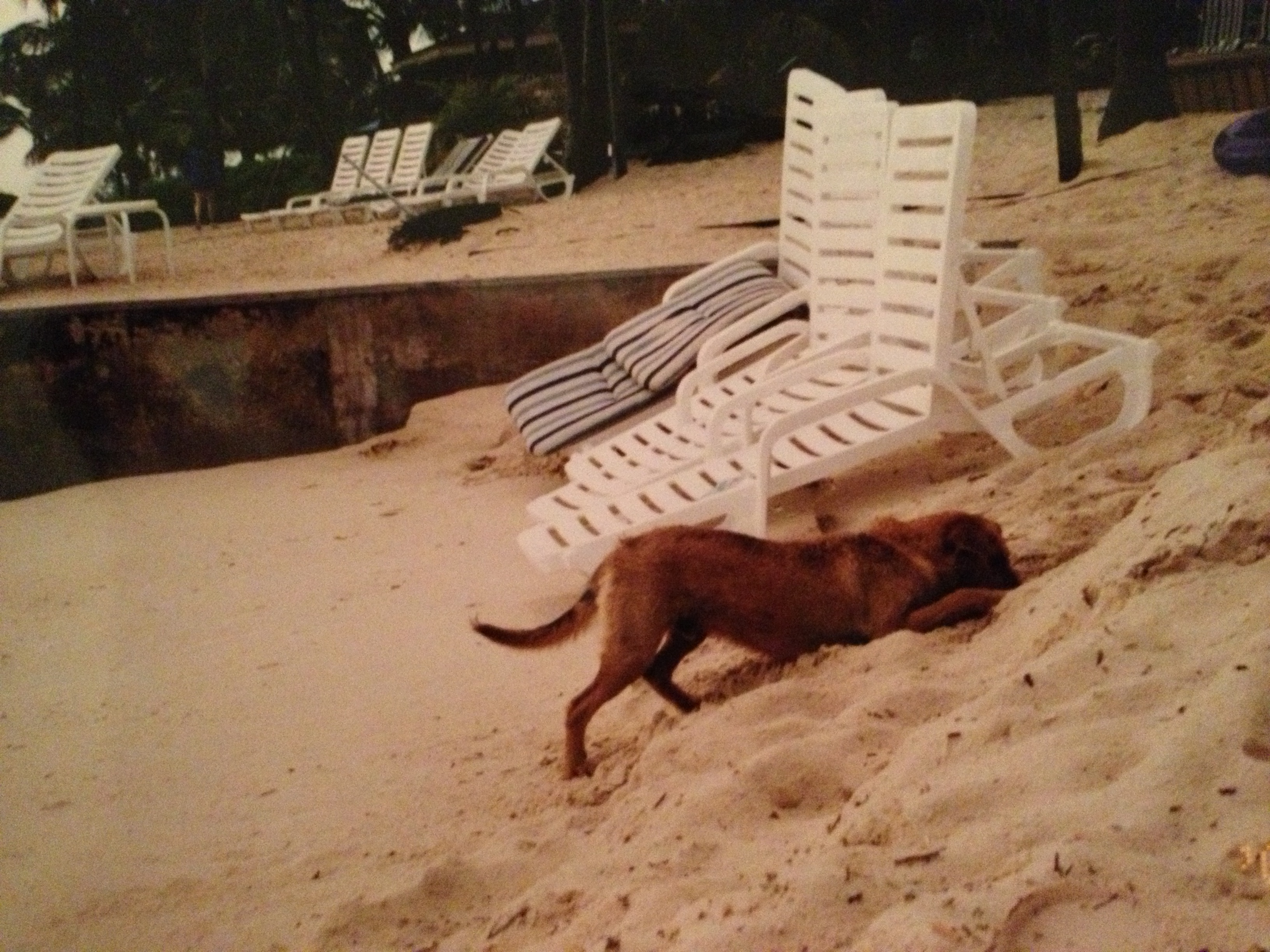
Xuma beacherOn the second day of our vacation, I noticed one particular stray dog hanging around our hotel beach. I said, “John, do you see that dog chewing on a coconut shell? He’s so thin, and look at all the bloody sores.”

John declared with a sigh, “I see. The poor pup.”

One night after dinner, we brought him some filet mignon. Careful not to scare him away, John and I approached the famished, feeble creature. He hesitated—we knew it would take time and patience to earn his trust. After a moment’s indecision, he meekly approached and delicately lifted the piece of meat from John’s hand.

He’d retreat a few safe steps away from us, then devour the meat and return for more. After he’d eaten several bites, he began dashing off with the rest to bury it in the sand.

Xuma beach“Look, do you see what he’s doing?” John asked, obviously amused.

“He must be saving some for later.”

 We nicknamed our new friend Xuma. We decided that we had to do something to help our new friend. We found a brochure for an organization, Proud Paws, run by a British Veterinarian, Dr. Peter Bizzell out of the Palmdale Veterinary Clinic in downtown Nassau. We scheduled an appointment.  

Xuma lounge chairThe night before the appointment we planned to keep Xuma with us. We lured him with food until he got close enough to lasso with a rope we found dangling from a life preserver. Knowing pets were not allowed in the hotel we sat outside on patio chairs until all of the guests where settled in for the night. Once the coast was clear, we whisked Xuma into our arms and snuck him into our room. Xuma slept soundly. I am sure he knew we were there to take care of him and he appeared to trust us more with each passing minute.

When Dr. Bizzel met us in the examination room, he took one look at Xuma and exclaimed, “You got yourselves a Potcake!”

It turned out, “Potcake” is the Bahamian term for the thick, leftover food that remains in the bottom of a pot of peas and rice after several reheatings. Traditionally, Bahamians fed potcake to the indigenous dogs that freely populated the Bahamas. Hence the dogs have come to be known as Potcakes.

As he examined Xuma, Dr. Bizzel explained that some believe the original Potcakes came to the Bahamas with the Arawak Indians from Central or South America. Until very recently, all island dogs shared the same isolated gene pool.  “Potcakes are as close to nature’s perfect genotype dog as possible,” he said. “It’s an extremely unique species of canine.”

Some islands’ Potcakes look more like the typical “pariah dog” found in locales such as India and North Africa. They have smooth, short fur with little or no undercoat, cocked ears, a hound-like rib cage, and long terrier-shaped faces. More rare are the shaggy or rough-coat Potcakes but they do occur naturally. While the typical Potcake is brown, colors range from black, white, cream, yellow, and red. Adults stand about twenty-four inches high at the shoulder. Normal adult weight in the bush is about thirty-five pounds. Healthy, homed Potcakes can weigh anywhere from forty-five to fifty-five pounds. They have distinct characteristics of size and temperament. The Royal Bahamian Potcake is now a recognized breed in The Bahamas.

Dr. Bizzel vaccinated, dewormed, and treated Xuma for sarcoptic mange. We also had him neutered. Dr. Bizzel determined that he was around seven to nine months old.  He only weighed twenty-four pounds.

John asked, “What will become of him now?”

“You have two options,” Dr. Bizzel said. “Either release him back to the island or take him home with you.”

“Fly him back to the U.S.?” John asked, bewildered. It sounded like an impossible journey.

Dr. Bizzell responded with certainty, “Sure, no problem. I’ll have Jackie help you with the paperwork.”

Off we went with his assistant, Jackie, to the Bahamas Board of Health to complete the paperwork to take Xuma home. We had to purchase a crate. We thought we had a setback when we learned that Xuma couldn’t travel on the same airplane home with us. Our airline only flew turbo prop planes into the islands, and it would be too hot in the cargo area for a live animal. He’d have to fly on a different airline, so we bought him his own an airline ticket

When the day arrived for us to fly home we took Xuma to his check-in counter. Before placing him in the crate, I bent down next to him. I hadn’t realized how attached I’d gotten until I thought about how frightened he’d be alone in the belly of the plane. I felt tears on my cheeks and whispered in his ear, “You be a good boy, Xuma. I promise John and I will be there for you once you arrive in Philadelphia.”

Xuma was already visibly terrified by the airport, and so could offer no alleviation to our own anxiety. I put Xuma in the crate, closed the door, turned, and walked away.

“Just focus on the moment when we’ll be reunited,” John said. “We’re doing the right thing, Kristen.”

The flight arrived in Philadelphia right on time. We were elated to be reunited with our Xuma! We couldn’t wait to get him home to introduce him to our other dog, Buddy. In time, they would become the best of buddies.

XumaThe first month, he nearly doubled his weight, and his fur eventually grew back. Sometimes we still observe his survival instinct. Just like on that sandy beach when Xuma buried the steak, he will, on occasion bury a treat in our back yard. His prey drive still run deep in his veins; there’s rarely an opportunity for wild vermin to make it out of our yard alive. One of our favorite pastimes is to take the dogs hiking. Xuma with his inbred and intuitive nature will always lead us to the simplest and safest way up and down the mountain.

Only two weeks after we brought Xuma home Nassau was hit with an intense hurricane. We often wonder had we not brought Xuma home if we would have survived the storm.

IMG_2040 familyWe feel blessed to have found him. We know that fate brought us together that day will be forever grateful. We all live happily together, myself, John, Buddy, and our son, born after we brought Xuma home, Patrick.

Potcakes are an excellent choice for people who want to share their lives with an intelligent, quick-witted, and bonded companion. They’re graceful runners, intuitive, empathetic, and the right match for someone who wants a long-term, interactive relationship with another intelligent species.

Mean Dog, Part 8

Why Not Wyatt?

by Terri Florentino

For the first few days, Whiskey seemed depressed. He never left my side and barely ate a thing. Time passed, he started eating again, explored a little, and romped around with Tulley. When people came to visit, he greeted them with his whole body, wiggling with delight. It turned out that Whiskey was a delightful character, full of adorable antics.

I decided that a new name might help him progress. Because he was such a clown, I’d nicknamed him “Cowboy,” but thought the new name should resemble the old. Wyatt Earp was a cowboy, so why not “Wyatt?” It didn’t take that cowboy long to learn his name, and after a trip to the vet for blood work, vaccinations, and neutering, he got a clean bill of health. I started training right away.

The worst thing about Wyatt was serious: he lifted his leg on everything in sight. My biggest fear was that neutering wouldn’t change it. If he couldn’t be housebroken, I probably couldn’t find him a loving family of his own.

I kept him on a leash indoors and gave him a firm “No!” each time I saw him sniff and lift. Fortunately, he was easily shamed. Basic obedience moved swiftly; he wanted very much to please me. He learned so fast that I soon looked for a permanent home for him. The longer it takes to find a home, the harder the transfer is for the dog—and for me. Sometimes, after I’d placed a rescue dog I’d had for a long time, my husband, Ed, caught me crying. “Self-induced misery,” he’d tease.

Wyatt was a lively, loving dog and needed a home where he could get plenty of exercise, perhaps with children and other animals for company and fun. He’d also need someone willing to keep training him. That got me considering Karen, Jim, and Morgan. Karen was a runner and wanted a running partner. Jim was an avid outdoorsman. They would train him. What cinched it, though, was seeing how Wyatt loved children. He was sure to put a smile back on little Morgan’s face.

I wrote them an email: “How are you since losing Raine? I know it must be hard. I’m writing to tell you about Wyatt.”

“We’re still grieving,” Karen wrote back. “Thank you for letting me know about Wyatt. I need to talk to Jim. I’ll be in touch.” The very next day she wrote to ask a few questions about Wyatt. I answered her and offered to bring him to meet her family. “We’d love that!” she dashed back.

Tulleygoingride (1)The following weekend Ed and I packed up the truck with our two black-and-white buddies, Tulley and Wyatt. We headed out for the two-hour ride to New Jersey. Both dogs got along well, but liked to have their own space. Wyatt jumped all the way into the third seat, and Tulley camped out in the middle. After a long, companionable ride, we passed a large farm that brought the scent of manure rolling through the windows, and Tulley began to whine and pace from window to window.

“We must be getting close,” Ed said. “He remembers.”

“It’s been four years,” I said. “He can’t possibly know where we are!” How could Tulley remember a place he’d only seen flash by a car window at fifty-five miles an hour?

Sure enough, Ed was right. A few minutes later, as we pulled into their driveway, Tulley wailed with joy. He flung himself from window to window scrabbling to get out of the truck. Karen, Jim, and Morgan heard us arrive and came out to meet us. When we opened the door for Tulley, he rocketed straight at Jim and Karen in glee, almost knocking them over. They threw their arms around him. The worst had been forgiven and forgotten, and all they remembered was love. As for Morgan, who had transformed from a baby to a four-year-old girl in his absence, she kept her distance. Tulley paid her no attention.

When it was time, Ed kept Tulley busy with a tennis ball while I got Wyatt out of the truck. Wyatt met them eagerly, all wiggles. Morgan giggled and patted her new friend. So far, so good. Greetings over, we put Tulley back into the truck and brought Wyatt into the house. I kept him on lead and walked him through the main area of the house, room to room. He sniffed everything and never even considered lifting his leg. Then, we let him run off-lead in the fenced yard while Morgan sat nearby on her swing set. He zigzagged every inch of the yard, nose down, and thankfully did his marking there. Every few moments, to Morgan’s delight, he’d check in with her for another wiggle and kiss. She began to swing on her swing and sing to herself, improvising a song about wiggly Wyatt. Karen and I exchanged glances and smiled. So charming, so peaceful, so perfect.

She and I stepped back into the house to speak privately, leaving the men to watch over Morgan and Wyatt. No sooner had the door closed behind me than Wyatt was jumping and yelping against it. When we returned to the yard, he leapt on me in joyful relief and planted himself beside me. He wouldn’t let me out of his sight.

Apparently, Wyatt had grown very happy to consider himself mine. Now Karen and I exchanged worried looks.

How could we help Wyatt feel happy to belong to them?

Mean Dog, Part 7

Whiskey

By Terri Florentino

“Will you rescue my dog?”

Through the phone, I could hear his voice crack.

“He’s a Border Collie mixed with English Shepherd,” Bill said. The dog was living outside part time and in a basement of a building he was helping renovate. “This is no life for my best pal,” he said, “but right now I don’t even have a home for myself. It would destroy both of us if I had to leave him at a shelter.” The dog would need basic training, neutering, and vaccines. He choked up again as he said, “But he’s absolutely wonderful.”

WyattAs I pulled into the parking lot, I saw a man who looked like Grizzly Adams standing with a handsome, densely coated, tri-colored dog calmly sniffing around the end of a leash. As Bill and I shook hands, the dog walked right up to me, tail wagging. I put out my hand to let him sniff, and he nudged it, inviting me to pet him. I chuckled at his forwardness. I massaged my fingers through the thick fur on his neck then behind his ears, gradually moving down his back, under his belly, and toward his paws and ears, making sure he was safe to handle. He didn’t care what I did—he loved the attention.

“Like I told you, he’s friendly,” Bill said, smiling proudly through his beard.

“He sure is!” I ruffled his neck and ears. “What’s his name?”

“Whiskey’s what I call him.” Bill got him as a puppy from a friend. “We’ve been inseparable ever since. Four years.” Bill warmed to the subject and reminisced about Whiskey’s mischievous puppy days, his awkward adolescence, his good-natured adulthood, and many happy adventures up until now. “Four of the best years with my best pal.” He reached down and scratched Whiskey on the chest, and Whiskey looked up with adoration.

“How does he do with other dogs?”

“I don’t know,” Bill said. “We don’t really run into them.”

“We’re in luck—I brought one of mine.” I’d brought Tulley—he’d always been good with other dogs. I got him out of my truck, and we walk around together, keeping a a distance. Tulley wiggled and lowered his head, and Whiskey barked and pulled on the leash as if he wanted to bound over and say hello. I was pleased to see no sign of aggression. I let Tulley lead me over for a three-second meet-and-greet–more wiggles, wags, and noses. If anything, Whiskey was almost too friendly; he bounced in the air and tried to wrap his front legs around Tulley’s neck. Tulley welcomed the play, but Bill and I had business.

“You were right,” I said after returning Tulley to my truck. “Whiskey’s a great dog. I can find him a forever home.”

“Thank you,” Bill said, and his whole body seemed to slump. “Thank you, so much,” he said, his voice now quivering with emotion. He knelt and pressed his face to Whiskey’s muzzle. “Be sure to let me know if there is anything he needs.” He squeezed his eyes closed, and I thought I saw tears on his lashes. “Let me know how he’s doing.”

“I will. And you can visit any time.”

While Bill loaded up my truck with the dog’s crate, food and favorite belongings, Tulley watched intently from his crate, and Whiskey became uneasy—pacing, panting, and jumping onto Bill, sensing his anxiety. Bill’s tears were falling frankly. Once all of Whiskey’s belongings were loaded into my vehicle, Bill bent down to say his final goodbye. He buried his face into the dog’s neck, no longer able to contain his emotion. He sobbed, inconsolable. “You’re my best pal, okay? My best pal ever. This is what’s best for my best pal.”

Mean Dog, Part 6

Looks Like ‘Raine,’

by Terri Florentino

I went straight into the house and called Karen. “I have a lovely little female Border Collie that I’d like you and your family to meet.”

“How exciting!” she said.

I gave her some details about Raine. “She loves children. She just lives for them. Can you come meet her this weekend?”

“That would be great!”

Jim, Karen, and Morgan came to meet Raine and visit with Tulley. Tulley had not seen them since the day they dropped him off at the farm. Ed and I were curious about how Tulley would react, but decided that time alone with Raine first was more important, so we put Tulley in a crate to wait his turn.

Raine and Morgan

Raine and Morgan

Sweet and gentle, Raine was not the type to jump all over and get too excited during an initial welcoming. We allowed her to wander freely as they came inside. Little Morgan, now three years old, huddled close to her parents as Jim and Karen bent down to greet Raine. Tenderly Raine approached, calm and welcoming. Once Morgan realized that she could touch Raine without the fear of being bitten, she relaxed. I took Raine through a sequence of obedience commands to show them what she could do. I also brought out some toys and treats so they could all have some fun together. They absolutely adored her, and she seemed content with them. As I suspected, she was most fond of their little girl.

Then we let Tulley out. He greeted Jim and Karen then grabbed a ball.

Karen’s eyes lit up. “He wants to play!”

Morgan stayed close to her parents, and Tulley paid no attention to her. All the while Raine stood quietly and watched Tulley playing with the toys and people. As we discussed the details about Raine, Tulley ran up to Ed and stood next to him. Out of habit, Ed reached down and pet him all over his body.

“You can touch him on his back end?” Jim asked with amazement. “Tulley would never allow anyone to touch his back end. If someone tried, he would’ve bitten them.”

Ed was taken aback. “Once he trusted me, I could touch him anywhere.”

We all watched Morgan stroking Raine, who wagged her tail and dipped her head, sweetly looking into Morgan’s face. “Well?” I said, grinning.

Jim and Karen looked at each other, beaming. “We’d love to take her home!”

Raine and Morgan passing happy years.

Years pass for Raine and Morgan

We agreed that there would be a trial period. We would keep in close contact. And so we did, there were frequent emails with updates. Most were of charming pictures, stories and updates about how well Raine was doing. They loved that Raine was a social butterfly; all of the neighbors quickly got to know and love her. The relationship between Raine and Morgan was all I’d hoped–they adored each other.

A couple of years passed, all was well, and we kept in touch with the occasional email, pictures, and Christmas card exchange. Karen remembered Tulley’s birthday every year and sent him a toy through the mail.

One day Karen phoned, crying so severely I could hardly understand what she was saying. “Raine ran out into the road, right in front of a car.”

I could hardly breathe. “Tell me she’s at the hospital. Tell me she’s going to be okay.”

Karen wept. “She didn’t make it.”

There was a long pause. I was speechless; my lips quivered, my eyes streamed. I took a deep breath. “How are Jim and Morgan?”

“She doesn’t go down to the road. She stays with us. It was a teenager, a new driver, but that shouldn’t matter because she never goes down to the road. Never!” Karen stopped crying, as if it simply couldn’t have happened. It couldn’t be true; it must not be true. “She never goes down to the road. We have so little traffic here. So few cars, ever. And she never goes down to the road. She wants to be with us. She stays close to us.” Her voice began to break again. “It was dark. The kid said he didn’t see her. Oh, Terri! This is my worst nightmare!” She began to cry again. We both did.

Karen and I spent a very long time on the phone consoling one another. When we finally hung up, we promised to keep in close touch. I put down the receiver, buried my head in my hands, and sobbed until I had no more tears.

Morgan drew this picture and said, “Raine is sad because she misses us.”

Morgan's drawing "Raine in Heaven with God and a hairbrush"

Morgan’s drawing, “Raine in Heaven with a Tick, a Hairbrush to Remove the Tick, and God, Who Will Take Care of Her Now”

Mean Dog, Part 5

Tulley Finds a Home

By Terri Florentino

??????????

Tulley plays fetch with a young friend.

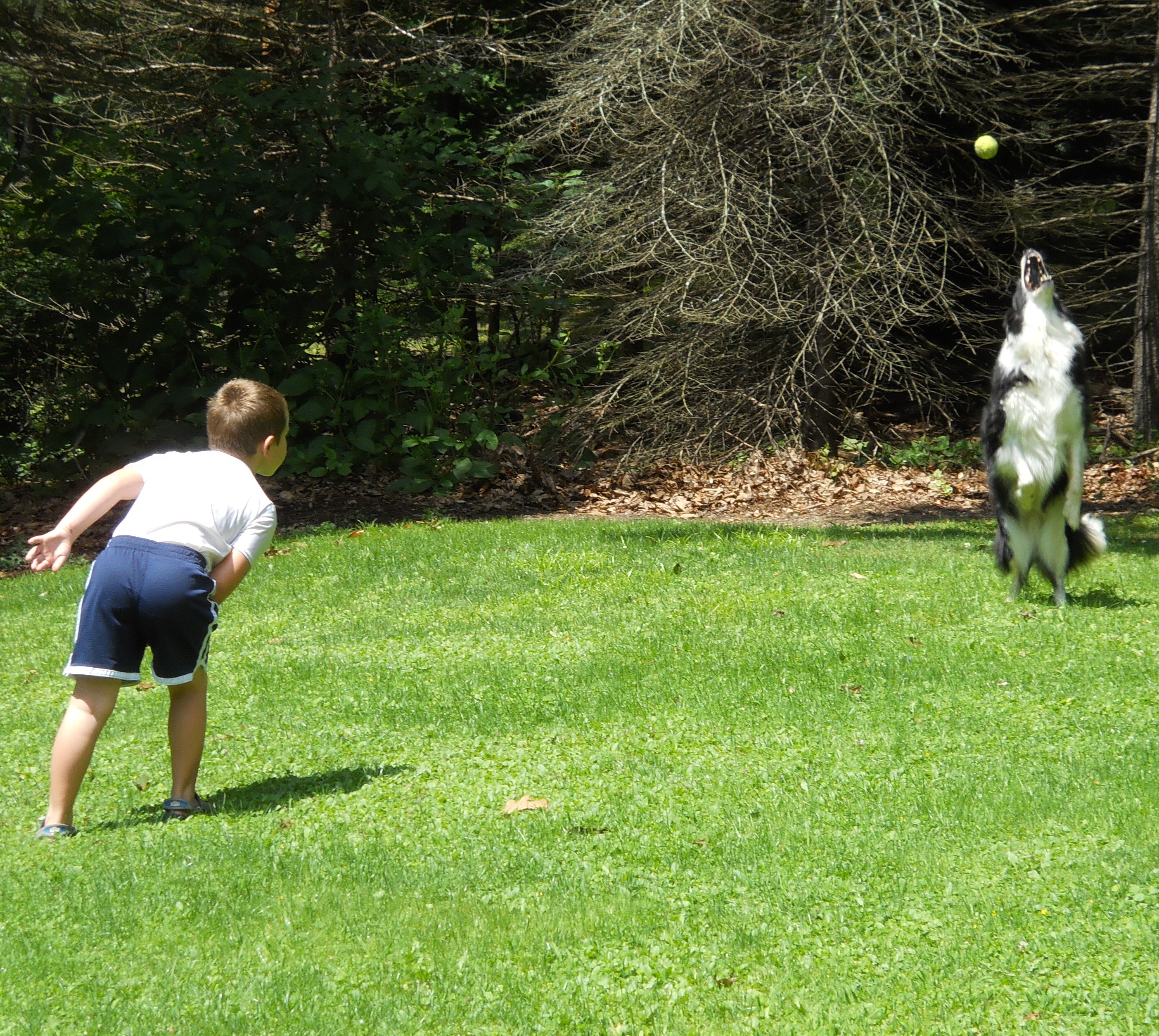
We were delighted with Tulley’s progress. We played the “touch and treat” game with as many people as possible and took him to a weekly agility class, where he moved, joyful and carefree, through the equipment, one obstacle at a time. He enjoyed inviting people to play fetch. Fetch allowed Tulley to work his “comfort zone.” Playing fetch seemed to be the only way Tulley was comfortable with children. I knew, if a child were to run up and touch him, he would have bitten him.

I called Tulley’s owner, Karen. “I’m pleased to tell you that he’s better-behaved with adult strangers.”

“How about children?” Karen said. Their daughter had already sustained one serious bite wound—they could not let it happen again.

“Well, he’s still uneasy with children when they come close, but he will play fetch with them.”

“Will we ever be able to completely trust him with our daughter?”

What could never be.

What could never be again.

“I wish I could make you that promise, Karen, but I can’t.”

“Ever?” Her voice quavered.

“I want more than anything to make you that promise, but I’d be remiss in giving you that guarantee.”

Karen sobbed as she spoke. “I understand. I’ll talk to my husband and let you know if we’d like you to continue the training.”

I hung up the phone, my heart heavy.

A few days later, Karen called. “What happens to Tulley if we can’t take him back? We couldn’t stand for anything bad to happen to him.”

“I’ll try to place him in a home without young children.”

She started to cry, this time so hard that her husband Jim took the phone from her. “If you’re absolutely sure that you can’t make him safe for our daughter, we’d like you to find him a new home.” Even Jim could barely speak the words.

When my husband got home later that day, we discussed Tulley’s fate. Ed agreed Karen and Jim were making the right choice. I told him I was afraid Tulley would lose ground during a re-homing process. “But the longer he stays with us, the more bonded he is. That’s going to make the transfer into a new home even more difficult.”

Ed sighed. “I don’t know, Terri.” He gazed at Tulley, who sat panting and watching us as if he knew we were talking about him. “We’ve always felt a kind of kindred spirit with Tulley, haven’t we?”

I smiled. Tulley had shown an immediate fondness for Ed. “You know,” I said, “Tulley chose you to be his person.”

Tulley and his "Forever Friend," Ed

Tulley and his chosen person, Ed

I called Karen. “Ed and I decided that Tulley will stay with us.”

“Really, you’ll keep him? I’m so happy!”

“Yes”, I said, “Ed and I have gotten very fond of him, and we’re concerned that he’d lose ground if he were re-homed.”

“I can’t thank you enough.”

“To tell you the truth, we’re thrilled to have him,” I said. “But will you do one thing for me?”

“Anything.”

“Will you let me find the perfect dog for your family?”

“Yes, please,” she said, laughing. “Nothing would make us happier.”

It came to pass that a sweet, two-year-old female Border Collie named Raine entered our lives.

Raine’s previous family had acquired her from me as a puppy. All new families make me a promise that if for any reason during the lifetime of their dogs they can no longer keep them, they must return them to me. My kids are always welcome to come back home, regardless of the circumstances.

Raine’s family, due to personal issues, could no longer keep her, but they were a nice family with a few young children whom Raine adored. The day the family brought her back to me, I will never forget. Three very young children embraced Raine while tears poured from their eyes and ran down their soft little cheeks. Raine stayed close, obviously sensing their sadness, licking their tears away as quickly as she could. As she watched them load into their vehicle, she became slightly frantic, sensing that separation from “her pack” was imminent. She paced, whined, and pulled on the leash as they drove away, leaving her behind.

It took Raine time to come out of her depression. Eventually settled into our day-to-day, however, she always seemed to harbor an underlying sadness. One particular day Raine was out in the front with my husband while he was doing some yard work. She was so mindful and well behaved that she would never leave the property, but this day, Ed called to me, “Terri! Have you seen Raine?”

I looked but didn’t see her anywhere. Then, a few houses away, I heard children’s laughter. “I think I know where I’ll find Raine.” I followed the sound of the children’s play. There amongst many young children sat Raine. She was the happiest I’d seen her since she lost her previous family.

Right then and there, I knew what I had to do. I left her playing with the children and went to make a phone call.