Tag Archives: inspiration

Finding Mick, Part 6

Try Me,

by Lisa Lanser-Rose

"He just wanted some rest."

“He just wanted some rest.”

After we dressed John in new pajamas, (“He just wanted some rest,” my mother had said), we sat on the patio, my mother on the swing, I in a chair across from her, each balancing a sourdough baguette, cheese, and tapenade sandwich on a plate. We ate like the damned, tearing the bread with our eyeteeth.

We had swallowed the last, thick bites when we heard the thump, jingle, and rattle of firemen rolling the stretcher down the front hall, and then, a duller sound, the firemen rolling the stretcher, more slowly, out.
You miss your dogs more than you do your husband.

“You miss your dogs more than you do your husband.”

For about a week after John’s death, I stayed to help with the kind of paperwork that requires other papers you don’t have. We got none of it done. I did what I could: I wrote the obituary. I opened an account online for John’s mourners to leave digital notes on a virtual grave. Mostly, I kept my mother company in person, my daughter company through Skype, and endured more time without the company of my dog. Being dogless is a hardship I don’t understand, but I suffered it from the time I was a toddler until I got my first dog at eleven years old. When I was married and my daughter and I flew to California without my husband, my mother used to tease me, “You miss your dogs more than you do your husband.”

Then came the day when my mother heard the thump, jingle, and rattle of me rolling my suitcase down her front hall. We heaved my suitcase into the trunk and headed for the airport shuttle depot. My mother gunned the engine to merge into traffic on Interstate Route 1. “Humans aren’t made to live alone,” she said. “I’ve never lived alone.”

“No way.” My mind flickered with views of every place I ever lived alone, from my graduate-school apartment to summers in every home I ever shared with Delaney—she’d abandon me for six weeks with her father. After she left, I’d spend a few days crying with Casey on the couch, then get up and love my life. I’d learned I could live alone anywhere, anytime. Try me.

The turn indicator clicked, and my mother piloted the car into a narrow gap in traffic. I gasped as the hood of her car eclipsed the license plate of the car in front of us. I put my foot on the imaginary brake on the passenger floorboard. “Mom. Slow down.”

Not made to live alone.

“I’ll be back next summer, me and my entourage.”

“I lived with my parents, then my roommates, then I married your father.”

“How about we slow down so we can see that car’s license plate?”

“When he left, I had you kids, then John. I’ve always lived with someone. My whole life.”

Until today. It dawned on me, when I left, she’d be alone for the first time in her life. “You have Ginger.”

“She’s John’s cat.”

I said, “If we survive this drive, I’ll be back next summer, me and my entourage.”

“Laura says I tailgate.”

“That whole multi-car pile-up thing? You’re how it happens.”

“Laura texts and drives.”

“You’re what? Seventy-one? The world is supposed to be tailgating you. Could you please just tap the brake, like three times?”

When I landed in Florida, Delaney and I had three days of her childhood left. I ferried her to Home Depot and Publix and Target and Borders and Bed, Bath and Beyond. We ate at all our places: Eddie and Sam’s New York Pizza and Sea-Sea
No room for Casey.

No room for Casey.

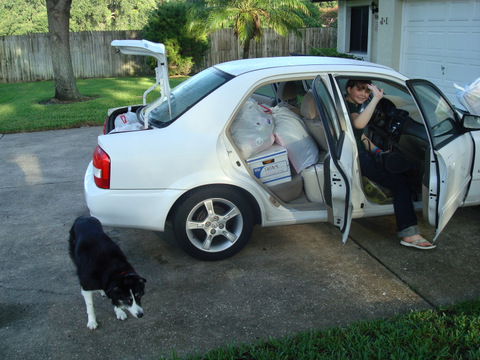
Rider’s and Tum Rub Thai and Gino’s. We went to Tampa Theatre and the Clearwater Cinema Café. We took Casey to the dog beach at Honeymoon Island. We found my heirloom steamer trunk and packed it with a desk lamp and a purple tool kit and a box of thumbtacks and Scotch tape and tampons, and lastly we tucked in a rolled-up Donnie Darko poster and the plush George the Curious Monkey doll that I bought for her when she was nine months old. When I heard there was a kitchen in the dorm, I hand-copied recipes for Delaney’s favorite ragout and vegan cupcakes and curry and Penne Franco. Delaney got mad at me when I fell asleep during our Kill Bill marathon. On campus move-in day, I took a picture of the loaded car with Delaney and Casey beside it. We were sad there was no room for Casey , but we were running late for the prescribed move-in hour, which made me anxious as we stood in line for the dorm key and then had to go to billing to clear up a mistake and then back in line for the key. When we finally got into the dorm room, Delaney’s roommate hadn’t yet arrived. I helped her rearrange the furniture and make her bed.

DSC02322I was just hanging her second Audrey Hepburn poster when she said, “Mom!”

“What?” When I saw her face had gone still, I froze.

“Thanks,” my daughter said.

She hugged me, and the strangest thing happened: my mom-life flashed before my eyes, or rather, it howled through me. Again she opened her eyes wide as the obstetrician clipped the umbilicus and convulsed as if she felt it. Delaney sat at her child-sized table and played with her Playmobil. Delaney swung her little fist at the dogs when they eyed her pizza. She waved good-bye when I left her at saxophone lessons, at horseback riding lessons, at math tutorials, at the airport gangway to board a plane to visit her father alone. Sunny Florida afternoons she sat with me on the lawn and debriefed me on her school day while I threw the Frisbee for Casey. Again Delaney and I laughed ourselves blue the time I pretended to aim  the car for a squirrel and horrified two mommies walking their children—I had to pull over down the block, out of sight—only the two of us knew why it was so funny. Again Delaney and I sniggered in the grocery store aisle because I was so impatient behind a slow old man that I mocked his gait outrageously enough to make John Cleese proud. Delaney and I bundled under a blanket in the dark to watch Ghost World. Delaney and I ate ice cream topped with chopped “Famous Anus” cookies and watched “Absolutely Fabulous” marathons. Again Delaney burst into my room in the middle of the night after a bad dream. Delaney strolled into my bedroom while I got dressed and said, “Wow, I’ve never met anyone so determined to look like a goober.” Again Delaney and I rode to school together every morning and home together every afternoon day after day, year after year, in city after city after city after city. Delaney and her girlfriends quipped downstairs in our living room while I crouched upstairs grateful that my home was filled with such rambunctiously sarcastic young women.

I loosened my grip and pulled away. Our curls tangled together, just for a moment, then slid free with soft, separate, bounces. “Okay,” I said. “That’s it, then?”

"Bye, Mom."

“Bye, Mom.”

Say It When You Feel It

curl your ears

Sadie, a pit bull rescue

Finding Mick, Part 5

Remember Yosemite

by Lisa Lanser-Rose

“It’ll be another day or so.” The hospice nurse clicked her pen. “He wanted to sleep through it. He’s sedated. Come with me.” She took us into the bedroom where John lay on his side, back to us. She showed us the medication and explained how to keep him asleep while he died. “Remember, he can hear you. Right up to the end.”

She left us standing beside John. We heard the front door open and close as she let herself out. John faced the window, away from us, sleeping heavily. I remembered him saying, I keep hoping, ‘This is it.’ Then I wake up, and I’m still here.

I said, “Is this it, then, John?”

“This is it,” my mother said.

The birds still had fight in them.

The birds still had fight in them.

We didn’t know what to do with ourselves. We went out on the patio. The ravens, whom my mother had named Edgar and Lenore, floated down and hopped along the fence. “They’re looking for sandwich crusts. I leave some out this time of day.” She went back inside the house, came out with an English muffin, and laid pieces of it on the rail. “They have one fledgling this year,” she said. I took some muffin and helped her. I could smell the pitch in the wood, feel the heat of it under my fingers. I had kicked off my shoes; the gravel in the garden hurt my feet.

Listlessly, we stood unprotected from the sun and searched the curled leaves of the oak for the youngster. The leaves looked dusty. The relentless summer sun had disintegrated everything, but the birds still had fight in them. Off to one side stood the bluebird box on its pole, with the bright red umbrella John mounted to give shade for the chicks. The two bluebird parents darted back and forth so fast that we had no will to watch them. We retreated into the shade and sat ourselves on the swing once more.

“It is what he wanted.” My mother turned up the hem of her shirt, found a small factory sticker there, and pulled it off. “He wrote emails to his doctor begging him for help with the pain.” Her fingernails were as smooth and perfect as the halves of tiny eggs. “He never could get ahead of it. He’d ask the hospice nurses to kill him.  He wanted me to move him to Oregon where . . . He begged . . .”

The ravens croaked over the muffin bits. Their claws scraped the wood, and the stiff oak leaves clattered in the breeze. I said, “How awful for you, Mom.”

She sighed. “We need rain.”

A person who’s entered “active dying” lies inert. Perhaps it’s called “active” because activity surrounds the patient: self-conscious prattle directed at the dying person, pointless bustle, frequent checking for the passive signs of active dying, and horrid jokes, such as, “I wish the nurse had fitted him with a pop-up timer.”

Time doesn’t hurtle as it does on Earth.

Everything about my own father’s death came back to me: mottled feet and hands, long pauses in respiration, slack mouth, a rattle in the throat. The suspense is brutal, the agitation intolerable, but on this way-station satellite, an hour, a day, has no meaning. Time doesn’t hurtle as it does on Earth. We became timeless women who pinched John’s toes like Hansel’s witch. Into the oven I’d throw banana bread, propelled by the notion that John had been waiting for it for twenty years. It couldn’t be too late.

“I have an electric mixer,” my mother said.

But I needed to mix it under my own effort. Beating the dough with a wooden spoon kept me upright. I had two recipes open on my laptop—one for banana bread, and one for active dying. We did not Skype Delaney. If we saw her seeing us, the spell might be broken.

As I slid four pans into the oven, my mother said, “What are we going to do with all that banana bread?”

“There’ll be lots of people.” We avoided each other’s eyes. My teeth hurt from clenching.

“It’s time for another dose.”

We did as Janice had instructed. The house filled with the aroma of banana bread. Delaney called on the phone, but we didn’t talk long.

“I’m going to take Casey outside to play Frisbee,” Delaney said.

That was my former life--a place with an outside.

My former life–a place with an outside.

Funny to think that was my former life—a place with an outside, where Frisbees could be tossed to a Border Collie I loved. I no longer knew that yard, that young woman who was my daughter, that old dog. I understood, logically, that it was awful not to know them, but I didn’t feel it. I paced. I needed something to do.

“I wish I knew how to knit a shroud,” I said to Delaney, but, unlike my mother, she didn’t get the joke. After I hung up the phone, I went looking and found my mother sitting on the hospital bed next to John. ”

"It's his favorite place on Earth."

“It’s his favorite place on Earth.”

The bedroom was crowded with oversized solid cherry furniture: bureau, nightstands, sleigh bed, armoire, and beyond it all lay John, silhouetted high against the sunlight by the sliding glass door. The previous day, hospice had called six firemen to move John into a hospital bed to ease his breathing. They had positioned and raised the bed too much like an altar. Head elevated, he lay upon it on his side, just as Janice had arranged him, facing the sliding glass doors that opened onto the patio.

The sliding doors made a glass wall from which we could see almost everything John had placed in his garden. Beyond the dappled shade and flowers ran the wood fence upon which my mother and I had laid muffin bits for ravens. Along that fence John and my mother had trained six different kinds of table grape vines. The vines thrived and my mother fretted there was no one to help prune them. I said I’d do it before I left.

We could take figs, still warm from the sunshine.

We could take figs, still warm from the sunshine.

At one corner of the yard John had set up their busy bluebird box and sheltered it with its cheerful umbrella, the one all passersby commented upon. To the right muscled the monstrous fig tree that we all climbed when the figs were ripe so that we could take them, still warm from the sunshine, and eat them with a tiny pat of bleu cheese. Beyond the fence ran a steep slope, a stream that pattered with frogs, a walking trail, and a nature preserve, in the canopy of which the two ravens raised their yearly brood.

When she heard me enter, my mother turned her head. “I was just reminiscing with John about Yosemite. It’s his favorite place on Earth.”

IMGP9156

The unthinkable view.

I sat beside her. “Yeah?” It was important to keep talking to John, saying pleasant things. I couldn’t feed him banana bread, but I could keep the woman he loved talking about his favorite place. “So why does he love Yosemite so much?”

Together we staged a cheerful interview about Yosemite National Park: the soaring vault of Half Dome, the unthinkable view from Glacier Point, the summer snow, the sound and the scent of mist at the base of Bridalveil Falls, and the cry of coyotes echoing against the valley walls. Behind John, the breeze tousled dappled shadows and light over the glass. Everywhere the confetti of flowers flew. Bluebirds and goldfinches sailed, blue and yellow, to and fro.

"I think he's on his new planet now."

This is it.

My mother said, “I think he’s on his new planet now.”

We waited. We stared. John’s side didn’t rise. It was so. 

Birthday Cake, Razorblades, and Other Dog Food

What Has Your Dog Eaten?

by Lisa Lanser-Rose

Bar soap, a pump bottle of hand cream, a box of crayons, an entire can of Crisco shortening, a pumpkin (everything but the stem), a slice of pizza straight out of a stranger’s hand–all things my Pip-Thief stole and ate.

I was just watching it for you.

“I was just watching it for you.”

All of my dogs, from my childhood dog Patches to my present-day Mick, stole and ate food–or things I never considered food. Whatever the case, stories of the time the dog ate something forbidden, or something dangerous, or something expensive, or something impossible, or something hilarious, all become highlights in the narrative of life with our dogs. Tell us your tales! Just click on “Leave a Comment” below.

To get you started, let me ask:

  • What’s your favorite “I Can’t Believe My Dog Ate It” story?
  • Did your dog know it was wrong to eat something she ate?
  • Did you and your dog ever disagree about what was “edible?”
  • Did your dog wait until you weren’t looking?
  • Were you ever afraid your dog ate something deadly?
  • Did your dog ever steal a holiday meal?
Got a crime-scene photo? Share it!

Got a crime-scene photo? Share it!

And if you like stories about dogs eating what they shouldn’t, please click “like” and follow us here, and like and follow us on Facebook.

Finding Mick, Part 4

Grand Plans

by Lisa Lanser-Rose

John's garden.

John’s garden.

Over the following week, as my mother and I cared for John, I carried my laptop with Skype video of Delaney from room to room. She rode around with me like a disembodied head in a rectangular clamshell. One night she had been frightened alone in the house, so we even slept side-by-side in Skypespace.  The next morning, I carried the laptop to the kitchen counter like a virtual bassinette. My mother and I whispered so as not to wake her.

A hospice nurse arrived, one I hadn’t yet met, Janice. “Good morning’!” she sang out. “You two look tired!”

Three thousand miles away, my daughter rolled over and disconnected us.

“Go out! Get lunch! Enjoy each other,” Janice said. It was an order.

John's Sun Gold Cherry Tomatoes.

John’s Sun Gold Cherry Tomatoes.

My mother ducked into the bedroom. She and John murmured while I sent an email to Delaney explaining we’d be back in an hour.

My mother and I converged in the hall, I in jeans and T-shirt, she in cotton eyelet Capri pants, a tailored top bright with poppies, gold and diamond jewelry, a distressed bronze leather Gianni Bini handbag, matching shoes, and a cloth grocery bag.

“I should’ve ironed my T-shirt,” I said.

“You look fine,” Janice said, shooing us. “Go on!”

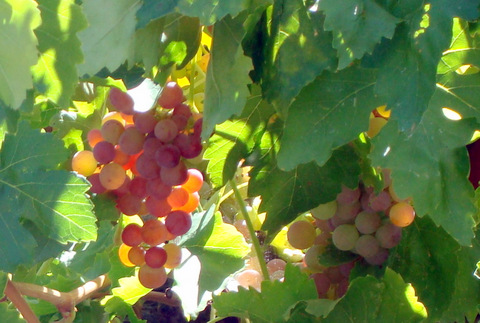
John's grapes.

John’s grapes.

We did as we were told. The air was dry and clear, the sun fierce, as you can see in these pictures I took of the yard that week, but a light breeze blew and made the shade delectable to the skin. We got soup at a tiny bistro and enjoyed the illusion that we were just women who might be out shopping for shoes or taking in a matinee rather than space-shuttling a dear man to his death.

John's pears.

John’s pears.

My mother pushed aside her wedge of sourdough and rested her spoon on the plate. She always looks fantastic—classy, refined, stylish, well put-together. Even when everyone else has the same style on, she seems overdressed. She’s fine-boned, with a pointed nose and chin, frosty blue eyes, and a dashing asymmetrical haircut that has become her signature.

She shifted uncomfortably in her seat, and after a long pause, she said, “When I was a girl, old people didn’t live alone. Young couples lived with parents before they bought a home or had children. Older people moved in with their children. Single adults never left home.”

Casey would love a road trip!

Casey would love a road trip!

“What I’m thinking,” I said, hoping I heard her right, “is Delaney will put in a year at USF, and, next summer—I can’t put Casey on a plane. She’s too old. But she’d love to ride in the car smelling her way across the country. Next summer, I’ll put Delaney, Casey, and the cat in the car and drive west.”

She smiled. We had heard each other. Finally, after thirty years of fallout from the fire, divorce, and dissolution of my childhood home, what was left of the family would gather together again. She sat up straighter with stifled joy; a lady maintains temperance in conversation. Instead of whooping, she said, “I’ve always wanted to drive across the country.”

I’m not a lady. I threw my arms wide. “Come with us! I can finally take you to New Orleans! I’ll stuff you with gumbo and jazz!”

“There are lots of places around here where you can teach—Sonoma State . . .”

I nodded. We would focus on the practical. “Delaney can work a year, establish residency . . .”

A meal I made for my mother with produce from John's garden.

A meal I made for my mother with produce from John’s garden.

“She belongs in California.” My mother lifted her iced tea, took a long sip, and set it down. The ice tinkled and whirled like the diamonds on her bracelet. “It won’t cost you much to live with me.”

I concentrated on proper use of my soupspoon—you scoop away from yourself, at twelve-o’clock. I let the weight of what she said sink in.

Into my uncertain silence, she added, “You’ll have time to write another book.”

We lifted our soupspoons and trembled with how wonderful and awful it was.

I said, “I wish Delaney’s disembodied head had been on the table to hear this.”

My sister Laura visited one day. When I moved west, we could visit any day.

When I moved west, my sister Laura and I could visit any day we wanted.

“When we get home,” my mother said, “let’s look up Sonoma State.” On the way, we stopped at the grocery store to get ingredients for banana bread.

The previous night, my mother had told me, “Every year John hoped you were going to send another loaf of bread.” When I was young and poor, at Christmas I sent my mother and John a dessert bread—banana or strawberry or rhubarb—because that’s all I could afford. And I was ashamed. Once I earned more than subsistence wages, I entered a modest but more respectable league of gift giving. I sent Jackson and Perkins rose bush seedlings, or amaryllis bulbs, or a holiday table runner. I never knew John appreciated my humblest gift the most.

John told the nurse I was his daughter.

John told the nurse I was his daughter.

Even though he was just my stepfather, John had been more thoughtful to me than any man I’d ever known. He was generous with praise and time, with food and money—especially food. He loved food like an Italian man should; the irony of esophageal cancer wasn’t lost on us.

The night before, I remembered, he’d taken small bites of macaroni and cheese, so he could eat some fresh-baked banana bread. I’d seen a bunch of freckled bananas in the kitchen. I would bake for him and fill his house with the scent. He’d take a few bites and know I loved him. We hurried home.

The view from the porch swing.

The view from the porch swing.

Janice intercepted us in the kitchen and cornered my mother. “While you were gone, John and I had a talk,” she said. “I asked him if he wanted to stay asleep. He said he did.”

I counted the bananas. I had enough for four loaves.

“Shouldn’t he have discussed it with me?”

I turned around. “What’s going on?”

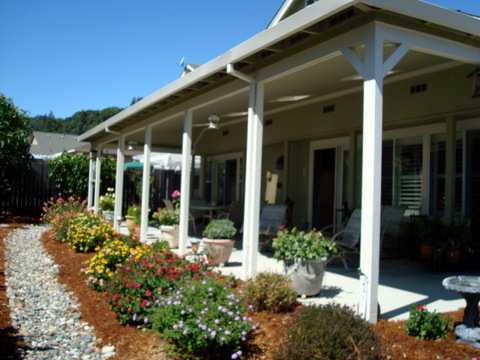
My mother's flowers and the porch swing under the sunshade.

My mother’s flowers, John’s dry creek bed, and the porch swing.

My mother stood in the middle of the kitchen with her purse still hanging from her shoulder. Her collarbone looked as delicate as a bird’s behind the pressed scalloped collar of her blouse. The countertop and cabinets, the floor and furniture, everything unhinged. The house floated and turned as if in the eddy of a flood. I sought my sea legs. I lost any sense of direction. The spaceship was docking—I could hear it in my mother’s voice.

Finding Mick, Part 3

Welcome to the Satellite

by Lisa Lanser-Rose

The next morning, John woke on this planet. He said, “Richard came by.” My uncle Richard had died of lung cancer years before. “He wants me to take his medicine for him.”

“I’ll fetch it for you,” my mother said.

Delaney video-phoned me through Skype. “Idiopathic vestibular disorder!” She had searched the Internet for Casey’s symptoms and made her diagnosis. “It’s a bout of dizziness that comes on suddenly and then clears up fast. It’s this harmless thing that happens to old dogs.”

“You’re talking about vertigo, which, I’ll have you know, your aunt Laura and I get–did you just call us ‘old bitches?’”

“Yes. Yes, I did. Casey’s already better. I mean, she’s so off-balance she can hardly walk, but she insists on following me around. She stood at her bowl to eat her dinner. She goes out to pee. She climbs the stairs.”

“She’s my hero,” I said, which was what I always said about Casey.

“When I grow up,” Delaney said, “I want to be just like Casey.”

She peered into my shoebox diorama.

Delaney gazed into my shoebox diorama.

To peer at me in her laptop screen, Delaney leaned forward and down, like a person looking into a shoebox diorama. I felt like a tiny toy, a Llego person.

“You want to see her?” Delaney made some rustling sounds, and I seemed to float and whirl, weightless. I teetered around the coffee table, then settled on the carpet, below Casey’s eye level. Casey’s nose examined the keyboard in front of me and found something edible. Her tongue licked twice, then her face turned aside. Her eyes canted right, right, right.

From somewhere high above me Delaney’s voice said, “She’s better, don’t you think?”

“Yeah.” I guessed so. Her head wasn’t tilting. The movement of the eyes might have slowed. I peered at the grainy ghost of my dog on the screen. It seemed marvelous that I could see and hear her in real time, but it was terrifying that couldn’t reach over and thump her shoulder. Was this how it was on the International Space Station? I might as well have left the planet altogether. My mother and I had rocketed off with John to his satellite way station. Life on Earth went on without us. Soon, his spaceship would dock. It would carry him away, and my mother and I would parachute back to Earth.

“Casey,” I said, and she glanced toward the screen, then away with narrowed eyes. Dogs like her don’t fall for figments.

My view soared upward, Casey’s face dropped away, and my throat clenched. Some part of me protested, probably the part that, when I was a baby, howled when something I loved disappeared.

“Rick and I are taking her to the vet in an hour, but she’ll be better. Vestibular disorder doesn’t last long.” Delaney gazed into my shoebox diorama, filling my screen with her round face, button nose, and doe eyes. The corners of her mouth twitched; she was trying not to gloat. “In the words of Dr. Gregory House, it’s ‘idiopathic,’ Latin for ‘we’re idiots for not figuring it out.’” She laughed, and I envied her sharp memory and wit. “Later today you’ll pay the vet to tell you what I just told you. If she says anything more, it’s just so you feel you got your money’s worth.”

“It’s always worth a hundred bucks to hear you say you told me so.”

“I’m value-added,” she quipped, having picked up the jargon-of-the-week from my job in the public school system. Her eyes were fixed on a corner of the screen, where she could see a small, inset box of herself as I saw her. She was enjoying the view, as well she should.

“You’re in a good mood,” I said.

“Casey’s okay. I’m sure of it.”

I was sure of it too. In fact, I was sure I’d known all along that nothing serious was wrong with Casey. I congratulated myself for not running up flight-change penalties and throwing everyone into a tizzy.

Delaney’s brow knit. She said, “How’s . . .” and swallowed.

“He says he’s going to another planet soon.” I nodded. “He talks about circles. There’s a circle he has to complete. He tries to explain but it doesn’t make any sense, and he gets frustrated. He just knows that when he completes the circle, he can go to his new planet.”

“Oh. Wow.”

“Oh! You’ll like this, when he’s asleep, his mother comes to him. He says their old cats come for him, too, Amber, Crystal, and Karma.”

She tucked a lock of her looping dark curls behind her ear and admired the effect. I remembered doing the same at her age. She said, “Wow.”

Herdainty face joined mine in the tiny Skype box

Her dainty face joined mine in the tiny Skype box

Suddenly my words tumbled, “He introduced me to the hospice nurse as his daughter. Not his stepdaughter. He told her that everything was fine now that his beautiful daughter was here.” I let myself cry.

Delaney’s gaze turned to the image of me on her screen. “Oh, Mom!”

Dry-eyed, my mother came over and squeezed my shoulder. She leaned forward to peer into the screen, and the image of her dainty face joined mine in the tiny Skype box. “He talked to my brother,” she said. I could tell by her tone of voice she knew it was cool that we were living in a satellite way station between the living and the dead. “John has to take his medicine for him. He also has to take Ted Kennedy’s.” Ted Kennedy was dying of brain cancer.

Through the laptops we three looked straight at each other, but because the lentil-sized camera lens is situated in the top of the laptop screen, we only saw each other looking down. With Skype, it’s impossible to look into each other’s eyes. I wished we could implant the little lentil cameras in them.

Later that day, I paid a good deal of money to the vet, who told me Casey had had an innocuous attack of idiopathic vestibular disorder. In just a couple of weeks, Casey and I would be together again.

Casey and I would be together again.

Casey and I would be together again.

Image

Have You Hugged Your Best Friend Today?

thanks buddy

Mean Dog, Finale

Safe and Loved

by Terri Florentino

I must admit I felt a connection with Wyatt. He’d look at me with those big, round, dark brown eyes as if he saw and loved my very soul. I had tried not to give him too much of myself, knowing he couldn’t stay. After all, now that Tulley had joined our family, I knew too well that six dogs were our limit.

Morgan at Six Years Old

Wyatt with Karen and Morgan

At this juncture neither Karen nor I were convinced that Wyatt would make a suitable companion for their family. We all went back inside together and discuss Wyatt’s training and feeding and sleeping schedule. While we decided his fate, he trotted through the house, following Morgan and inspecting her every move. Morgan talked to him, “C’mon, Wyatt. This is a stuffed-animal tea party, and you can be our guest.” Wyatt hung on her every word, which pleased the little girl mightily.

As we talked, occasionally Jim knelt and called to him. Wyatt dashed over and wiggled as Jim ruffled his fur all over. Finally, Jim turned to Karen, “I say let’s give him a try.”

Lost in her play-pretend, Morgan had seemed oblivious to the adult conversation, but right on cue she piped up, “Oh! Can we keep him, Daddy?”

Jim and Karen blurted, “Yes!” Then Karen added, “If Wyatt is happy, we would love for him to stay.”

“Wonderful!” I said, but my enthusiasm sounded a bit forced. Puzzled, I looked at Wyatt anew—could it be this was good-bye? What in the world had I expected?

Knowing how intuitive he was, I tried to conceal my sorrow. “Do you have that crate we talked about?”

“Yes,” Karen said.

“Put him in the crate and don’t let him out until after I’m gone.” I managed to hold back my tears. “I don’t want him to see me leave.” Just then, Wyatt walked over and slid his head onto my lap. I cupped his face. “You’re a good boy. . . . I’ll always be with you.” Everyone began to sniffle.

Ed stood up. “Okay, let’s go, honey.” I let him guide me to my feet and put his arm around me.

Karen escorted Wyatt to another room and the crate. At the door, Karen embraced me—no words, just strength, trust, and love.

Merry Christmas, Wyatt

Merry Christmas, Wyatt

Karen emailed me often. Morgan loved Wyatt from the start. He joined in many a tea party, fashion show, and Disney-movie reenactment. At first, he didn’t know what to do with himself, which was saying a lot, because Wyatt had a big personality. With so much attention from a family so happy to have him, he acted like a kid in a candy store. Overcome with glee, he’d race through the house and leap from couch to chair to chair. They realized quickly how right I was about his need for training, and they diligently obliged.

Wyatt was a counter-surfer, and for this, Karen asked my advice. I replied, “Don’t leave things on the counter to tempt him, and he may forget to surf.” That cured it, but one St. Patrick’s Day, Wyatt had a little lapse. Karen had made corned beef and cabbage and left it to cool on the counter. A half hour later she returned to find the entire meal had vanished. Wyatt had sprawled himself out on the kitchen floor, lounging with a look of self-satisfaction. He practically shrugged at her, as if to say, “Hey, you obviously didn’t want it. What’s the problem?”

Morgan and Wyatt

Morgan and Wyatt

At first, Wyatt was haunted by old fears and anxieties. Whenever he rode in the car with Karen and she stopped at the supermarket or strip mall, he’d panic and try to keep her from getting out, as if remembering the day his first owner gave him up in a parking lot. Eventually, he learned to love car rides, but it took time and a lot of reassurance. Summer storms frightened him; sometimes they’d find him hiding in the clothes dryer. When left alone for long periods, Wyatt scratched up the furniture, the floor, the doors. Karen used Rescue Remedy or Anxiety Relief drops, and Wyatt learned when he felt his fears coming on to go to her and sit obediently, as if to say, “Please, please, please may I have a few drops of the stuff?” He’d lift his lip and wait for her to squeeze the medicine into his mouth. Over time, he learned he was well-cared-for, and his fears subsided.

Morgan, Jim, and Wyatt

Morgan, Jim, and Wyatt

Last fall, while Morgan was asleep in bed and Jim was outside spotting deer, Karen decided to make a cup of tea before bed. Her heel slipped off the top step, and she went skidding down the wooden stairs on her tailbone. There she sat at the bottom with a dislocated shoulder, a concussion, and a likely broken coccyx, so painful that Karen heard herself wailing in a way she never had before. Wyatt dashed over and ran his eyes and nose all over her. Then he rocketed up on the couch in front of the picture window and barked and barked and barked. Jim was was spotting deer about thirty yards away and heard Wyatt’s bark. Afraid Wyatt would wake up Morgan, he came running to scold him, but instead found Karen injured and badly dazed.

You're safe, and you're loved.

You’re safe, and you’re loved.

Wyatt and Karen had grown very close, in part thanks to the three-and-a-half-mile runs. At one particular point halfway up a hill, Wyatt would stop dead in his tracks and sit right in front of the “SPEED LIMIT 25 When Horse Rider Is Present” sign. He refused to budge. Karen spoke firmly and tired to get him to heel, but nothing worked. Karen stood there thinking, “Seriously? Just move your tush up the hill. This is not hard!” She usually had to get back home to get Morgan on the bus and Jim off to work. Finally one day, as Wyatt sat by the sign like a cement statue, she leaned down, patted his head, and said in his ear, “Everything’s okay. It’s all fine. You’re safe, and you’re loved.” He relaxed, he wriggled all over, and then zipped up that hill like an Olympic athlete.

Wyatt still oversees all the movement in the house, off to work and school, over to the barn, out to bound in fresh snow, and up to bed, when he listens attentively to bedtime stories and often stays to sleep in Morgan’s room. Whatever’s going on, Wyatt is happiest when the family is all together.

Karen works from from home, and every afternoon like clockwork, Wyatt comes to her and whines. Engrossed in her work, she tells him to hush and lie down. He settles for a moment before fussing again—right around the time Karen looks up to see the school bus coming down the road. The house sits almost 800 feet from the road, and he starts to whine and pace about five minutes before she even sees the bus. Karen still can’t figure out how he knows Morgan is on the bus and it’s time to go get her.

Morgan and Wyatt in the snow

Morgan and Wyatt in the snow

Karen emailed me the other day, “I just said to Jim tonight that we’ve had Wyatt longer than we’ve had any dog. Hard to believe he’ll be ten years old in a few months.”

So many things had happened since their dear Raine had died. The whole world had changed for the mean dog who had become our own dear, old Tulley.

Karen wondered, “Where does the time go?”

I believe that there is an explanation for everything, so, yes, I believe in miracles. ~Robert Brault

Image

Mick’s Secret to Happiness

P1030256 (2)

Mean Dog, Part 7

Whiskey

By Terri Florentino

“Will you rescue my dog?”

Through the phone, I could hear his voice crack.

“He’s a Border Collie mixed with English Shepherd,” Bill said. The dog was living outside part time and in a basement of a building he was helping renovate. “This is no life for my best pal,” he said, “but right now I don’t even have a home for myself. It would destroy both of us if I had to leave him at a shelter.” The dog would need basic training, neutering, and vaccines. He choked up again as he said, “But he’s absolutely wonderful.”

WyattAs I pulled into the parking lot, I saw a man who looked like Grizzly Adams standing with a handsome, densely coated, tri-colored dog calmly sniffing around the end of a leash. As Bill and I shook hands, the dog walked right up to me, tail wagging. I put out my hand to let him sniff, and he nudged it, inviting me to pet him. I chuckled at his forwardness. I massaged my fingers through the thick fur on his neck then behind his ears, gradually moving down his back, under his belly, and toward his paws and ears, making sure he was safe to handle. He didn’t care what I did—he loved the attention.

“Like I told you, he’s friendly,” Bill said, smiling proudly through his beard.

“He sure is!” I ruffled his neck and ears. “What’s his name?”

“Whiskey’s what I call him.” Bill got him as a puppy from a friend. “We’ve been inseparable ever since. Four years.” Bill warmed to the subject and reminisced about Whiskey’s mischievous puppy days, his awkward adolescence, his good-natured adulthood, and many happy adventures up until now. “Four of the best years with my best pal.” He reached down and scratched Whiskey on the chest, and Whiskey looked up with adoration.

“How does he do with other dogs?”

“I don’t know,” Bill said. “We don’t really run into them.”

“We’re in luck—I brought one of mine.” I’d brought Tulley—he’d always been good with other dogs. I got him out of my truck, and we walk around together, keeping a a distance. Tulley wiggled and lowered his head, and Whiskey barked and pulled on the leash as if he wanted to bound over and say hello. I was pleased to see no sign of aggression. I let Tulley lead me over for a three-second meet-and-greet–more wiggles, wags, and noses. If anything, Whiskey was almost too friendly; he bounced in the air and tried to wrap his front legs around Tulley’s neck. Tulley welcomed the play, but Bill and I had business.

“You were right,” I said after returning Tulley to my truck. “Whiskey’s a great dog. I can find him a forever home.”

“Thank you,” Bill said, and his whole body seemed to slump. “Thank you, so much,” he said, his voice now quivering with emotion. He knelt and pressed his face to Whiskey’s muzzle. “Be sure to let me know if there is anything he needs.” He squeezed his eyes closed, and I thought I saw tears on his lashes. “Let me know how he’s doing.”

“I will. And you can visit any time.”

While Bill loaded up my truck with the dog’s crate, food and favorite belongings, Tulley watched intently from his crate, and Whiskey became uneasy—pacing, panting, and jumping onto Bill, sensing his anxiety. Bill’s tears were falling frankly. Once all of Whiskey’s belongings were loaded into my vehicle, Bill bent down to say his final goodbye. He buried his face into the dog’s neck, no longer able to contain his emotion. He sobbed, inconsolable. “You’re my best pal, okay? My best pal ever. This is what’s best for my best pal.”