Tag Archives: herding dogs

Keeping Mick

Mick is always ready for anything.

Mick is ready for anything.

Terri and I want to apologize and thank you for your patience. Our work here has come to a halt since Mick, of “Finding Mick,” suffered his second mysterious and potentially fatal health crisis. I’ve been distracted, distraught, and exhausted. Terri, with the help of her friend and colleague Megan Biduk-Lashinski, has been researching and networking, doing her part to save him.

Ears!

The Ash Wednesday Dog

Born with the mark of a cross on his forehead, Mick is the inspiration for the “Inquisitor” in our name and the model for many of our posters and promos.

In September he turned one year old. He was the runt of his litter, but I didn’t choose him because he was small and frail. Quite the opposite–he was small, yet anything but frail. I wanted a courageous, independent, outgoing canine partner, a dog who could meet the world with a frank and friendly attitude. Mick has been that dog.

P1040081

Mick likes to help me with my chores.

I expected Mick to be hard-headed. I was braced for a disciplinary challenge, but he turned out to be eager to please me always.  He’s been at my side wherever pet laws allow, and then some. He’s completed puppy class and beginning obedience and is slated for introduction to agility. I teach in a public school, where Mick instantly became a beloved mascot. He frequents local businesses and restaurants. Around town, people are starting to recognize him, “Oh, that’s the famous Mick!”

His failure to thrive began early. We’ve spent a lot of time in local pet food shops, where his charm inspired employees to try to find a food to please and nourish him. Like many of his breed, he’s spooky-smart, but he’s also sublimely sweet, unflappable, and ready for anything.

His last trainer said, “I’ve seen a lot of awesome dogs. Mick is a super-awesome dog.”

Mick with his Uncle Pike.

Mick tries to keep up with his Uncle Pike.

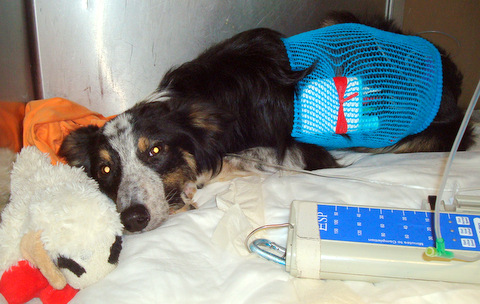
DSC06785This past July Mick spent eight days in intensive care. Last week, he again required round-the-clock care, this time for four days. As in July, doctors have run every test they can think of to figure out what’s trying to kill our Mick. Again and again, test results come back normal–or if they’re abnormal, they’re mystifying. It’s now clear that Mick is fighting a rare and deadly disease. He’s been recovering quickly from his latest “crash,” but we’re still waiting for a diagnosis and praying for a cure.

P1030446While we await the latest test results, Mick is back at home and gaining strength. Terri and I began work on a new series of “Dusty” stories for you. We’ll keep you posted about Mick’s outcome.

It was a long journey finding Mick. It’s been a long year trying to keep him. I feel certain we’re close to a diagnosis and a cure. He loves and is loved by way too many people–nobody’s losing Mick!

Finding Mick, Part 7

You and Me, Casey

by Lisa Lanser-Rose

Casey's not going anywhere.

Casey

After moving my only immediate family member out of my house, I drove the forty-five minutes home thinking about everything other than the fact that I’d just cut my heart out and stored it in a cement-block dorm room. When I got home, I took Casey outside to play Frisbee, just as we did every day. Delaney might as well have been over at a friend’s house for the afternoon. I sat on the grass, and Casey dropped her Frisbee near my feet and whined until I threw it. When I did, rather that rocket after it the way she used to, she watched it sail and skid onto the grass, then whined at me. We weren’t the creatures we once were, she and I. “I can’t reach it,” I said, and she fetched it. I threw the Frisbee and Casey panted to and fro, stopping occasionally to drink out of my water glass, which made it her water glass.

Against the horizon in my mind, the sails of dark thoughts approached: my mother, my stepfather John, my father. Casey was in her final years, but for me, there were more to come. . . . I decided I had stuff to do. I got up, and we went into the kitchen, but when we got there, it turned out I had nothing to do in there.

So I took the stairs two at a time, Casey behind because she wasn’t fast enough anymore to head me off the way Border Collies do. When I burst into my bedroom, I stopped short, and Casey bumped into me. I had nothing to do in my bedroom either.

I veered toward the rubble in Delaney’s bedroom, but at the sight of my only child’s ransacked room, a howl rose in my throat. Casey knocked into me, and I closed the door before I made a noise.

Casey and I swerved and trotted down to the kitchen. I had people to call—my mother and my friend Nina, or maybe someone in the tribe, or maybe Fred or Dan or Vito, three men whom I kept as friends as long as we never discussed falling into love or falling into bed. But when I sat on the kitchen stool and picked up the phone, I was wrong about that, too. I put the phone back on its charger.

I'm here! I'm here!

I’m here! I’m here!

Casey suggested we try the living room and led me in there, but I couldn’t think of anything to do there, either.  She looked at me sideways, her jaws parted slightly in a leering pant. Her body seemed padded and ponderous as she stepped toward her orthopedic dog pillow, glancing back at me over her shoulder to see what I thought of her suggestion that we maybe lie down on it together for a while?

We tried that. I stroked her shoulders and face, and she put one paw on my chest and pushed until her elbow locked, keeping me at arm’s length. She’d always done that, as if she liked being close, but not too close. We lay there for several ticking minutes. Her eyes closed. Her locked leg vibrated. The air conditioning shut off. The refrigerator shut off. On nearby I-19, the traffic amplified its stage whisper, giving its incessant soliloquy that this was the most densely populated county in Florida, with an average of thirty-three hundred people per square mile and three-hundred-and-eighty thousand cars on the road, an average of fifty-two highway deaths a year on this stretch, far, far from woodland and farmland and sheep, under a sky scribbled with wires and littered with billboards. My stomach growled. I asked Casey, “Want dinner?”

Casey was stone deaf, but we understood each other. We both got up.

I bounded to the kitchen, and, laboriously, she followed. It was time for dinner, time to scoop some dog food, haul open the fridge, and start cooking, as I’d done nearly every day since I’d gotten my own kitchen twenty-four years before—but I was wrong again. Once I’d poured kibbled into Casey’s bowl, there wasn’t anyone else to feed.

Casey inhaled her kibble like a Shop-Vac. The cat slithered seductively against the kitchen faucet. I opened a drizzle for her. A stillness settled in my brain.

Casey tiptoed up behind me, panted, and burped.

I went down on my knees and wept. With her paws, Casey pried my hands away from my face to bump me with her nose and lick me, and I rolled away and keened. I had loved every second of my days and nights as Delaney’s mom. I had loved her and loved the woman I was in her company. Frightened, Casey came around and shoved her nose between my hands and face, and I got up. I rinsed my face in the sink, then went down again. If I couldn’t be Delaney’s mom anymore, I didn’t want to be anyone else.

I cried until a headache shut me up. I ate a bowl of cereal so I could keep an aspirin down and went to bed. About three in the morning, I woke and remembered. Delaney’s room was located exactly where it always had been, across the hall, behind a closed door, but now it gaped in the dark like the maw of a mausoleum. I slid off the bed to cry on Casey. We huddled on the floor, clinging to each other, the lone survivors.

Audrey the Afterthought Cat

Audrey the Afterthought Cat

And somewhere in the house, there crept an afterthought, a cat.

Day after day, night after night went on like this. Casey had always slept near the foot of my bed, which meant that I had spent fourteen years making a Border-Collie-sized birth around the foot. In the middle of these post-apocalyptic empty-nest nights, I had to get out of bed and crawl on the floor if I wanted to sob into her coat. I had never before made such use of my dog, but it became a midnight ritual. Like other physiological acts that involved uncontrolled bodily sounds and fluids, unhinged grief was best performed behind a locked door, with access to toilet paper and running water.

The dog was wet for two months.

Good News, Everyone!

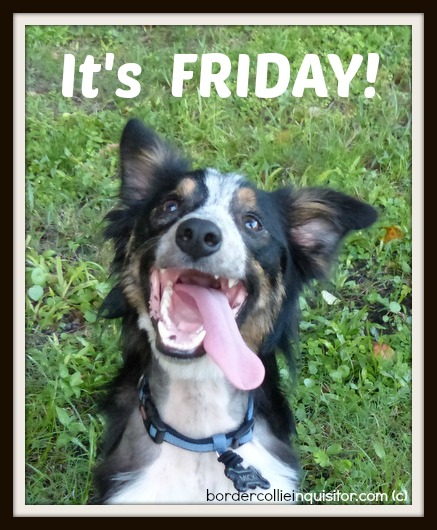
Giddy goofy!Mick and the rest of us at BCI

wish you a happy weekend!

Finding Mick, Part 6

Try Me,

by Lisa Lanser-Rose

"He just wanted some rest."

“He just wanted some rest.”

After we dressed John in new pajamas, (“He just wanted some rest,” my mother had said), we sat on the patio, my mother on the swing, I in a chair across from her, each balancing a sourdough baguette, cheese, and tapenade sandwich on a plate. We ate like the damned, tearing the bread with our eyeteeth.

We had swallowed the last, thick bites when we heard the thump, jingle, and rattle of firemen rolling the stretcher down the front hall, and then, a duller sound, the firemen rolling the stretcher, more slowly, out.

You miss your dogs more than you do your husband.

“You miss your dogs more than you do your husband.”

For about a week after John’s death, I stayed to help with the kind of paperwork that requires other papers you don’t have. We got none of it done. I did what I could: I wrote the obituary. I opened an account online for John’s mourners to leave digital notes on a virtual grave. Mostly, I kept my mother company in person, my daughter company through Skype, and endured more time without the company of my dog. Being dogless is a hardship I don’t understand, but I suffered it from the time I was a toddler until I got my first dog at eleven years old. When I was married and my daughter and I flew to California without my husband, my mother used to tease me, “You miss your dogs more than you do your husband.”

Then came the day when my mother heard the thump, jingle, and rattle of me rolling my suitcase down her front hall. We heaved my suitcase into the trunk and headed for the airport shuttle depot. My mother gunned the engine to merge into traffic on Interstate Route 1. “Humans aren’t made to live alone,” she said. “I’ve never lived alone.”

“No way.” My mind flickered with views of every place I ever lived alone, from my graduate-school apartment to summers in every home I ever shared with Delaney—she’d abandon me for six weeks with her father. After she left, I’d spend a few days crying with Casey on the couch, then get up and love my life. I’d learned I could live alone anywhere, anytime. Try me.

The turn indicator clicked, and my mother piloted the car into a narrow gap in traffic. I gasped as the hood of her car eclipsed the license plate of the car in front of us. I put my foot on the imaginary brake on the passenger floorboard. “Mom. Slow down.”

Not made to live alone.

“I’ll be back next summer, me and my entourage.”

“I lived with my parents, then my roommates, then I married your father.”

“How about we slow down so we can see that car’s license plate?”

“When he left, I had you kids, then John. I’ve always lived with someone. My whole life.”

Until today. It dawned on me, when I left, she’d be alone for the first time in her life. “You have Ginger.”

“She’s John’s cat.”

I said, “If we survive this drive, I’ll be back next summer, me and my entourage.”

“Laura says I tailgate.”

“That whole multi-car pile-up thing? You’re how it happens.”

“Laura texts and drives.”

“You’re what? Seventy-one? The world is supposed to be tailgating you. Could you please just tap the brake, like three times?”

When I landed in Florida, Delaney and I had three days of her childhood left. I ferried her to Home Depot and Publix and Target and Borders and Bed, Bath and Beyond. We ate at all our places: Eddie and Sam’s New York Pizza and Sea-Sea

No room for Casey.

No room for Casey.

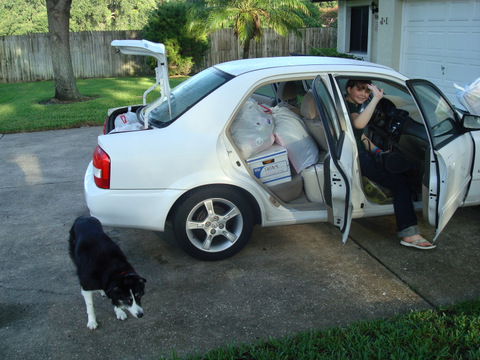
Rider’s and Tum Rub Thai and Gino’s. We went to Tampa Theatre and the Clearwater Cinema Café. We took Casey to the dog beach at Honeymoon Island. We found my heirloom steamer trunk and packed it with a desk lamp and a purple tool kit and a box of thumbtacks and Scotch tape and tampons, and lastly we tucked in a rolled-up Donnie Darko poster and the plush George the Curious Monkey doll that I bought for her when she was nine months old. When I heard there was a kitchen in the dorm, I hand-copied recipes for Delaney’s favorite ragout and vegan cupcakes and curry and Penne Franco. Delaney got mad at me when I fell asleep during our Kill Bill marathon. On campus move-in day, I took a picture of the loaded car with Delaney and Casey beside it. We were sad there was no room for Casey , but we were running late for the prescribed move-in hour, which made me anxious as we stood in line for the dorm key and then had to go to billing to clear up a mistake and then back in line for the key. When we finally got into the dorm room, Delaney’s roommate hadn’t yet arrived. I helped her rearrange the furniture and make her bed.

DSC02322I was just hanging her second Audrey Hepburn poster when she said, “Mom!”

“What?” When I saw her face had gone still, I froze.

“Thanks,” my daughter said.

She hugged me, and the strangest thing happened: my mom-life flashed before my eyes, or rather, it howled through me. Again she opened her eyes wide as the obstetrician clipped the umbilicus and convulsed as if she felt it. Delaney sat at her child-sized table and played with her Playmobil. Delaney swung her little fist at the dogs when they eyed her pizza. She waved good-bye when I left her at saxophone lessons, at horseback riding lessons, at math tutorials, at the airport gangway to board a plane to visit her father alone. Sunny Florida afternoons she sat with me on the lawn and debriefed me on her school day while I threw the Frisbee for Casey. Again Delaney and I laughed ourselves blue the time I pretended to aim  the car for a squirrel and horrified two mommies walking their children—I had to pull over down the block, out of sight—only the two of us knew why it was so funny. Again Delaney and I sniggered in the grocery store aisle because I was so impatient behind a slow old man that I mocked his gait outrageously enough to make John Cleese proud. Delaney and I bundled under a blanket in the dark to watch Ghost World. Delaney and I ate ice cream topped with chopped “Famous Anus” cookies and watched “Absolutely Fabulous” marathons. Again Delaney burst into my room in the middle of the night after a bad dream. Delaney strolled into my bedroom while I got dressed and said, “Wow, I’ve never met anyone so determined to look like a goober.” Again Delaney and I rode to school together every morning and home together every afternoon day after day, year after year, in city after city after city after city. Delaney and her girlfriends quipped downstairs in our living room while I crouched upstairs grateful that my home was filled with such rambunctiously sarcastic young women.

I loosened my grip and pulled away. Our curls tangled together, just for a moment, then slid free with soft, separate, bounces. “Okay,” I said. “That’s it, then?”

"Bye, Mom."

“Bye, Mom.”

Birthday Cake, Razorblades, and Other Dog Food

What Has Your Dog Eaten?

by Lisa Lanser-Rose

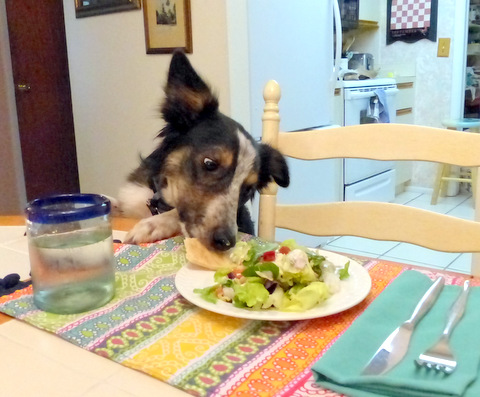
Bar soap, a pump bottle of hand cream, a box of crayons, an entire can of Crisco shortening, a pumpkin (everything but the stem), a slice of pizza straight out of a stranger’s hand–all things my Pip-Thief stole and ate.

I was just watching it for you.

“I was just watching it for you.”

All of my dogs, from my childhood dog Patches to my present-day Mick, stole and ate food–or things I never considered food. Whatever the case, stories of the time the dog ate something forbidden, or something dangerous, or something expensive, or something impossible, or something hilarious, all become highlights in the narrative of life with our dogs. Tell us your tales! Just click on “Leave a Comment” below.

To get you started, let me ask:

  • What’s your favorite “I Can’t Believe My Dog Ate It” story?
  • Did your dog know it was wrong to eat something she ate?
  • Did you and your dog ever disagree about what was “edible?”
  • Did your dog wait until you weren’t looking?
  • Were you ever afraid your dog ate something deadly?
  • Did your dog ever steal a holiday meal?
Got a crime-scene photo? Share it!

Got a crime-scene photo? Share it!

And if you like stories about dogs eating what they shouldn’t, please click “like” and follow us here, and like and follow us on Facebook.

Image

Hold It . . . Hold It . . .

IMGP9515

Image

You Did NOT Just Boop My Nose.

IMG_0025 (1)

Jigsaw Julia

The Art of Toy Herding

by Patricia Kimbell, BCI Contributor

Julia's "I'm So Bored" Look.

Julia’s “I’m So Bored” Look.

Julia, my five-year-old, smooth-coated Border Collie, couldn’t play outside or practice her Agility skills very long each day due to the severe Texas heat this summer.  She learned to conquer her boredom by “herding” her toys.

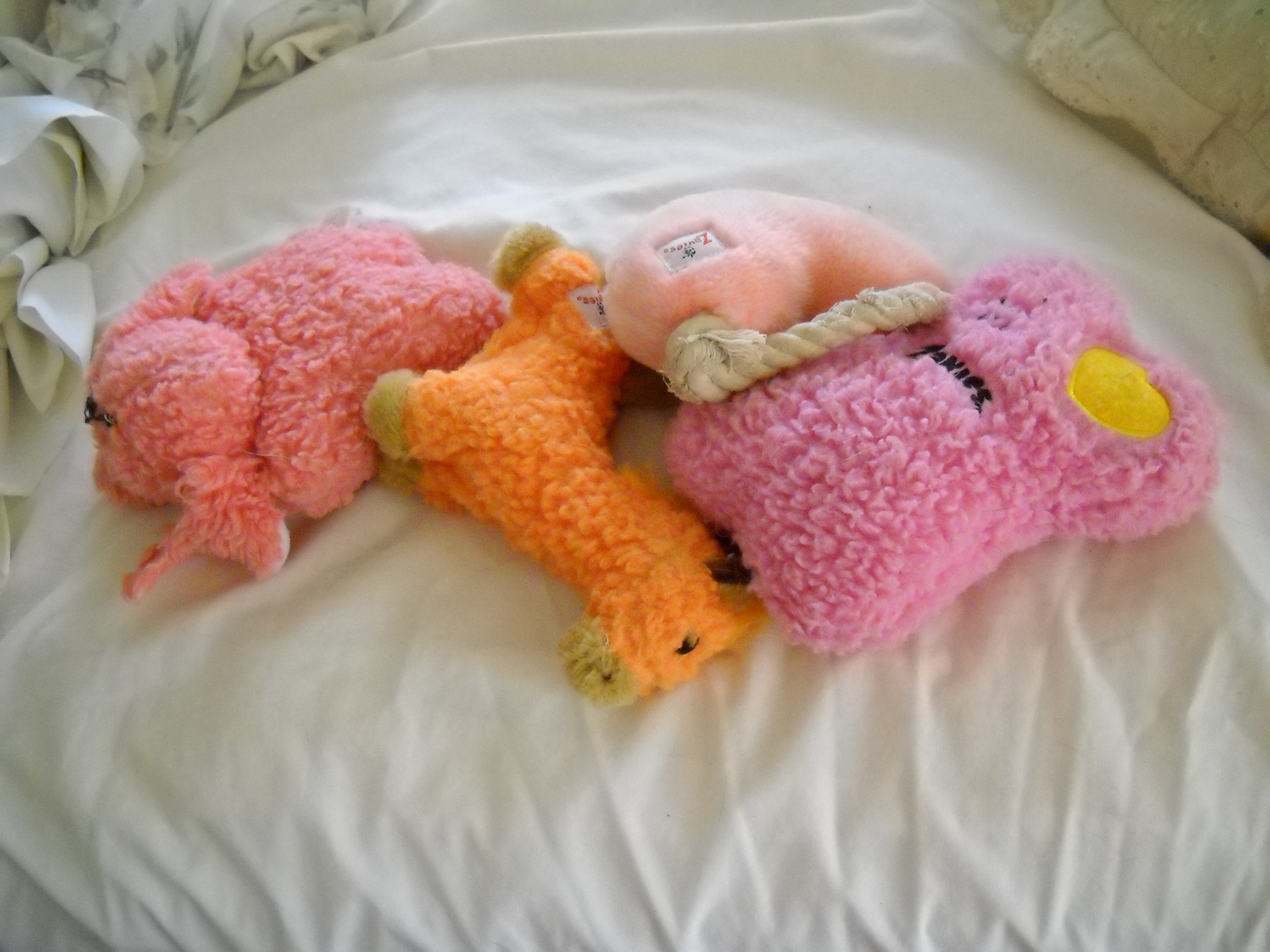
Sometimes she arranges them, always the pink ones, on the floor and most times on her bed.  Apparently, pink is her favorite color, as she always chooses that color from her toy box. The color choice surprises me, because I had always heard that dogs were colorblind.

She may not be able to control anything else in her little world, but she can control the order of her toys!

DSCN1281

DSCN1307DSCN1326I could find no information on any other BC exhibiting this behavior, so thought you might like to see pictures of Julia’s toy arrangements.

The intricate way in which she intertwines her toys reminds me of a jigsaw puzzle.

Four years ago, I found her at an abandoned ranch near me when she was approximately a year old.  She was  starving  and heart-worm infected, trying to dig water out of a dried-up pond. That was on the 4th of July, hence the name “Julia.” She’s the best thing that ever happened to me.

5205096764708059358We began Agility training and so far  she has added five titles to her name!

Click to learn more and buy!

Click to learn more and buy!

Editor’s Note: Julia’s artistic arrangements are reminiscent of Dog Works: The Meaning and Magic of Canine Constructions by Vicki Mathison.

Image

Have You Hugged Your Best Friend Today?

thanks buddy

Finding Mick, Part 1

Mother, Daughter, Dog

by Lisa Lanser-Rose

The California Clan and I

The California Clan and I

For twenty years, I meant to head west. When we got to California, we could live the way human animals were meant to live. Blood relatives would belly up to our Thanksgiving table, wink, and joke that they didn’t feed my dog underneath. Women with my eyes, cheeks, curls, and hips would push grocery carts alongside mine. When my daughter walked on stage for a school recital, she’d look down into the eyes of kin looking up. They would single her out and smile–because she was theirs.

Even though I suffered the absence of kin as a kind of chronic illness, I had turned my two-human, three-species household into the happiest life I’d ever lived. I had about three weeks of it left when my mother called and asked me to come to California. She needed help taking care of her husband while he died.

She’d never asked me for anything before, so I said okay.

That meant my daughter and I scrapped our big plans for the last weeks of our last summer together before she left for college. Instead she’d spend that time at home alone with no one for company but our ill-tempered cat and our creaky old Border Collie, Casey. It hurt. Delaney and I were tight, the way some single moms are when they have just the one kid. Now our intrepid duo was coming to an accelerated end that I couldn’t picture for myself. I could picture it for Delaney—she’d order cheap pizza with her college roommate, pull all-nighters, plan flash-mobs on campus, lug clothes and quarters down to the laundry, screen zombie movie marathons in the common room. I’d made sure she had all the pencils, pajamas, and posters she’d need. As for me, after I helped her move into the dorm, I had nothing on my calendar.

_SC01443

The most beguiling ratios.

After six o-clock on a Friday evening, Delaney scooted aside so I could lug my suitcase past her. Casey, who used to rocket out ahead of me, lumbered behind me down the stairs. Delaney’s laptop lit up her face with the bright gray light of a hurricane sky. At eighteen, she was beautiful in the way of great beauties—her face had the most beguiling ratios of cheek-to-chin, eye-to-nose, and brow-to-lip, the kind that not only made people stare, but made them blurt out, “I’m sorry, but I can’t stop staring.” She looked nothing like me.

“We’ll Skype,” I said. “We can text while I’m at the airport.” I rolled my suitcase to the door. Casey came with me.

Casey’s pedigree said she was my dog, and so did she. For fourteen years I fed her, I trained her, I threw her Frisbee, millions upon millions of times. Casey was mine. If we ever did battle for custody of Casey, Delaney could’ve introduced into evidence a home video: four-year-old Delaney stands holding a puppy in her arms, whom the record will show was Casey at eight weeks. In it, you can hear my mommy-voice utter the incriminating line: “How do you like your new puppy?”

I gave Casey to Delaney because I wanted a daughter who wanted a cool dog like Casey as much as I did. That’s because when I was a little kid, even as young as four years old, I would’ve done anything to live side-by-side with a dog like Casey. But maybe Delaney was too young, or maybe Casey came too easily, or maybe Delaney’s brain was wired for feline. To her the dog was more conflict and competition than companion. A dog like Casey was in her way. A dog like Casey was my way.

Inter-species sibling rivals.

Inter-species sibling rivals.

And Casey knew it. While Delaney was growing up, Casey chased her and her friends through the backyard, staggered around the house wearing a princess gown, and let herself be tucked into My Little Pony bed sheets because I willed her to do it. Casey “keeked,” a term Donald McCaig picked up in Scotland from a shepherdess named Viv Billingham, “Tell me, does he turn his head back to you, looking for instructions? Keeking, we call it.” Casey keeked not to Delaney but to me, as if to ask, “You want me to wear this tiara? Oh, okay. I’d rather not wear a tiara while running a lawn-chair obstacle course with the kids, but if you want me to do what the kids want, okay.” If I’d beckoned, she’d have bolted to my side.

Every night when Delaney was still little, I pointed to the end of her bed, and Casey pointed at the door. She glanced back at me, not keeking but negotiating for a promotion—bedding down in my room. Resigned, she curled on the end of my daughter’s bed, always slightly panicked to see a door close between us. She’d lift her head one last time and then lower it, as if to say, “You sure? Okay, one more night.”

Finally Delaney grew into a teenager.  “Casey bugs me jumping on and off the bed while I’m trying to sleep.” And so Casey got her bedtime upgrade.

A family counselor would say the three of us—mother, daughter, dog—were “enmeshed.” Casey was the closest thing to a sibling my only child ever had. I had a lifelong case of  dog-aholism, and the three of us were deeply co-dependent—or is that “co-reliant?” Not a competitive sort, I didn’t see Border Collies as tickets to big sheep-trial purses, agility trophies, or rescue-network sainthood (even though I secretly craved and liked to think myself capable of all three). Nor was Casey the object of my otherwise unspent maternal excess—she was just my dog, which for most of us should be enough of a mighty thing.

Casey and I.

Mental fusion.

If neuroscientists ever studied Casey’s brain and mine, they would find mental fusion, mirrored neurological roots and branches twining and grafting. My brain had a caniculus or a “little dog” of Casey like the homunculus or “little man,” the neural map of my own body. After fourteen years of bonding with that dog, the Casey-region of my brain was especially large—never mind the Delaney-region. That was probably an entire continent.

In the foyer by the front door, I tried to slide a couple keys off my key ring without breaking a fingernail or bursting into tears. I said, “I can’t believe I’m leaving my girls.”

“The last three weeks of my last summer at home too,” Delaney deadpanned, without lifting her eyes from her laptop.

“Thanks, kid. That helps.”

According to my flight itinerary, I’d be taking the red-eye alone to California and returning in three weeks. The oncologists had given my stepfather two.

“Here’s the car key,” I said, even though Delaney didn’t have her license yet. “Just in case. The little one’s the mailbox key.”

“I know.”

The Border-Collie Mindmeld.

The Border-Collie Mindmeld–“Throw It.”

Casey wagged her tail and with her eyes tried to bore through my brow the command, “You’re taking me with you.” She couldn’t read the tickets through her cataracts, and even if she weren’t deaf she wouldn’t have listened to my rationalizations. Suitcases triggered rapid-cycling manic-depression in her—maybe adventure awaited! Maybe abandonment. Her tail popped up, ears forward, toes tippy-tapping, then her tail tucked down, her ears flattened back, her feet rooted in front of the door. She blocked my path in an unspoken demand that I could feel in my bones. The Casey region of my brain busied itself trying to figure out how to take her with me after all. I opened the door, knowing she’d shoulder it shut—

But this time she clattered sideways and fell over. When she tried to sit up, her head seemed to swing loose on her neck. I thought, “She’s having a stroke!” I was so scared, I could’ve picked up and thrown the whole house.

I dropped on my knees. “Casey!”

At the bottom of the stairs, Delaney hunched over the keyboard engaged in a battle of wit with an invisible someone, someone she’d probably never seen, someone unrelated to us. She machine-gunned whole sentences and smirked.

“Laney! Something’s wrong with Casey!”

“Oh, my God,” she said. She kept typing.

Head dipped to the right, Casey’s eyes shifted back and forth, faster in one direction, as if watching someone swing a cat. “I’m serious, Lane. Something’s wrong with the dog.”

Delaney put down her computer and came to see for herself. Her eyes widened. “Are you still going to go?”

The longer I'm a mother, the more I love my mother.

The longer I’m a mother, the more I love my mother.

My mind scrambled over the grown-up calculations we hesitate to share with our children: how much would it cost to reschedule my flight? How much would it cost to see the vet on a Saturday? How much do you invest in saving the life of a fourteen-year-old dog? How sick can she be when two months ago the vet said she was healthy enough to live to be twenty? How often do vets lie to pet owners to let them enjoy happier last days?

My Casey-dog was dying, just as my father had died, just as my stepfather, John, was dying. Should stay with my daughter while our dog dies? Should I keep my promise to my mother and help her shepherd her husband to his death? What good would I do here? What good would I do there? How should I decide?

My shuttle was late.