Author Archives: Lisa Lanser Rose

Finding Mick, Part 4

Grand Plans

by Lisa Lanser-Rose

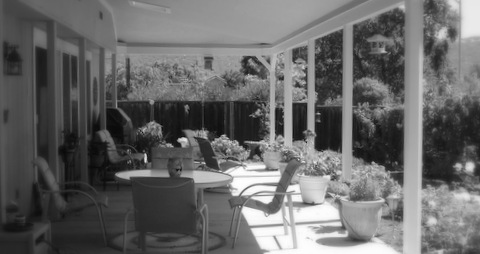
John's garden.

John’s garden.

Over the following week, as my mother and I cared for John, I carried my laptop with Skype video of Delaney from room to room. She rode around with me like a disembodied head in a rectangular clamshell. One night she had been frightened alone in the house, so we even slept side-by-side in Skypespace.  The next morning, I carried the laptop to the kitchen counter like a virtual bassinette. My mother and I whispered so as not to wake her.

A hospice nurse arrived, one I hadn’t yet met, Janice. “Good morning’!” she sang out. “You two look tired!”

Three thousand miles away, my daughter rolled over and disconnected us.

“Go out! Get lunch! Enjoy each other,” Janice said. It was an order.

John's Sun Gold Cherry Tomatoes.

John’s Sun Gold Cherry Tomatoes.

My mother ducked into the bedroom. She and John murmured while I sent an email to Delaney explaining we’d be back in an hour.

My mother and I converged in the hall, I in jeans and T-shirt, she in cotton eyelet Capri pants, a tailored top bright with poppies, gold and diamond jewelry, a distressed bronze leather Gianni Bini handbag, matching shoes, and a cloth grocery bag.

“I should’ve ironed my T-shirt,” I said.

“You look fine,” Janice said, shooing us. “Go on!”
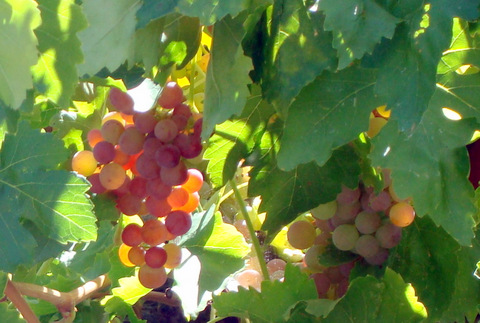
John's grapes.

John’s grapes.

We did as we were told. The air was dry and clear, the sun fierce, as you can see in these pictures I took of the yard that week, but a light breeze blew and made the shade delectable to the skin. We got soup at a tiny bistro and enjoyed the illusion that we were just women who might be out shopping for shoes or taking in a matinee rather than space-shuttling a dear man to his death.

John's pears.

John’s pears.

My mother pushed aside her wedge of sourdough and rested her spoon on the plate. She always looks fantastic—classy, refined, stylish, well put-together. Even when everyone else has the same style on, she seems overdressed. She’s fine-boned, with a pointed nose and chin, frosty blue eyes, and a dashing asymmetrical haircut that has become her signature.

She shifted uncomfortably in her seat, and after a long pause, she said, “When I was a girl, old people didn’t live alone. Young couples lived with parents before they bought a home or had children. Older people moved in with their children. Single adults never left home.”

Casey would love a road trip!

Casey would love a road trip!

“What I’m thinking,” I said, hoping I heard her right, “is Delaney will put in a year at USF, and, next summer—I can’t put Casey on a plane. She’s too old. But she’d love to ride in the car smelling her way across the country. Next summer, I’ll put Delaney, Casey, and the cat in the car and drive west.”

She smiled. We had heard each other. Finally, after thirty years of fallout from the fire, divorce, and dissolution of my childhood home, what was left of the family would gather together again. She sat up straighter with stifled joy; a lady maintains temperance in conversation. Instead of whooping, she said, “I’ve always wanted to drive across the country.”

I’m not a lady. I threw my arms wide. “Come with us! I can finally take you to New Orleans! I’ll stuff you with gumbo and jazz!”

“There are lots of places around here where you can teach—Sonoma State . . .”

I nodded. We would focus on the practical. “Delaney can work a year, establish residency . . .”

A meal I made for my mother with produce from John's garden.

A meal I made for my mother with produce from John’s garden.

“She belongs in California.” My mother lifted her iced tea, took a long sip, and set it down. The ice tinkled and whirled like the diamonds on her bracelet. “It won’t cost you much to live with me.”

I concentrated on proper use of my soupspoon—you scoop away from yourself, at twelve-o’clock. I let the weight of what she said sink in.

Into my uncertain silence, she added, “You’ll have time to write another book.”

We lifted our soupspoons and trembled with how wonderful and awful it was.

I said, “I wish Delaney’s disembodied head had been on the table to hear this.”

My sister Laura visited one day. When I moved west, we could visit any day.

When I moved west, my sister Laura and I could visit any day we wanted.

“When we get home,” my mother said, “let’s look up Sonoma State.” On the way, we stopped at the grocery store to get ingredients for banana bread.

The previous night, my mother had told me, “Every year John hoped you were going to send another loaf of bread.” When I was young and poor, at Christmas I sent my mother and John a dessert bread—banana or strawberry or rhubarb—because that’s all I could afford. And I was ashamed. Once I earned more than subsistence wages, I entered a modest but more respectable league of gift giving. I sent Jackson and Perkins rose bush seedlings, or amaryllis bulbs, or a holiday table runner. I never knew John appreciated my humblest gift the most.
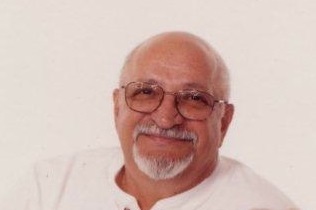
John told the nurse I was his daughter.

John told the nurse I was his daughter.

Even though he was just my stepfather, John had been more thoughtful to me than any man I’d ever known. He was generous with praise and time, with food and money—especially food. He loved food like an Italian man should; the irony of esophageal cancer wasn’t lost on us.

The night before, I remembered, he’d taken small bites of macaroni and cheese, so he could eat some fresh-baked banana bread. I’d seen a bunch of freckled bananas in the kitchen. I would bake for him and fill his house with the scent. He’d take a few bites and know I loved him. We hurried home.

The view from the porch swing.

The view from the porch swing.

Janice intercepted us in the kitchen and cornered my mother. “While you were gone, John and I had a talk,” she said. “I asked him if he wanted to stay asleep. He said he did.”

I counted the bananas. I had enough for four loaves.

“Shouldn’t he have discussed it with me?”

I turned around. “What’s going on?”
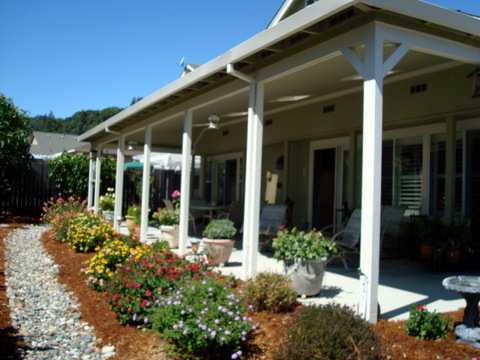
My mother's flowers and the porch swing under the sunshade.

My mother’s flowers, John’s dry creek bed, and the porch swing.

My mother stood in the middle of the kitchen with her purse still hanging from her shoulder. Her collarbone looked as delicate as a bird’s behind the pressed scalloped collar of her blouse. The countertop and cabinets, the floor and furniture, everything unhinged. The house floated and turned as if in the eddy of a flood. I sought my sea legs. I lost any sense of direction. The spaceship was docking—I could hear it in my mother’s voice.

Image

Hold It . . . Hold It . . .

IMGP9515

Image

You Did NOT Just Boop My Nose.

IMG_0025 (1)

Finding Mick, Part 3

Welcome to the Satellite

by Lisa Lanser-Rose

The next morning, John woke on this planet. He said, “Richard came by.” My uncle Richard had died of lung cancer years before. “He wants me to take his medicine for him.”

“I’ll fetch it for you,” my mother said.

Delaney video-phoned me through Skype. “Idiopathic vestibular disorder!” She had searched the Internet for Casey’s symptoms and made her diagnosis. “It’s a bout of dizziness that comes on suddenly and then clears up fast. It’s this harmless thing that happens to old dogs.”

“You’re talking about vertigo, which, I’ll have you know, your aunt Laura and I get–did you just call us ‘old bitches?’”

“Yes. Yes, I did. Casey’s already better. I mean, she’s so off-balance she can hardly walk, but she insists on following me around. She stood at her bowl to eat her dinner. She goes out to pee. She climbs the stairs.”

“She’s my hero,” I said, which was what I always said about Casey.

“When I grow up,” Delaney said, “I want to be just like Casey.”

She peered into my shoebox diorama.

Delaney gazed into my shoebox diorama.

To peer at me in her laptop screen, Delaney leaned forward and down, like a person looking into a shoebox diorama. I felt like a tiny toy, a Llego person.

“You want to see her?” Delaney made some rustling sounds, and I seemed to float and whirl, weightless. I teetered around the coffee table, then settled on the carpet, below Casey’s eye level. Casey’s nose examined the keyboard in front of me and found something edible. Her tongue licked twice, then her face turned aside. Her eyes canted right, right, right.

From somewhere high above me Delaney’s voice said, “She’s better, don’t you think?”

“Yeah.” I guessed so. Her head wasn’t tilting. The movement of the eyes might have slowed. I peered at the grainy ghost of my dog on the screen. It seemed marvelous that I could see and hear her in real time, but it was terrifying that couldn’t reach over and thump her shoulder. Was this how it was on the International Space Station? I might as well have left the planet altogether. My mother and I had rocketed off with John to his satellite way station. Life on Earth went on without us. Soon, his spaceship would dock. It would carry him away, and my mother and I would parachute back to Earth.

“Casey,” I said, and she glanced toward the screen, then away with narrowed eyes. Dogs like her don’t fall for figments.

My view soared upward, Casey’s face dropped away, and my throat clenched. Some part of me protested, probably the part that, when I was a baby, howled when something I loved disappeared.

“Rick and I are taking her to the vet in an hour, but she’ll be better. Vestibular disorder doesn’t last long.” Delaney gazed into my shoebox diorama, filling my screen with her round face, button nose, and doe eyes. The corners of her mouth twitched; she was trying not to gloat. “In the words of Dr. Gregory House, it’s ‘idiopathic,’ Latin for ‘we’re idiots for not figuring it out.’” She laughed, and I envied her sharp memory and wit. “Later today you’ll pay the vet to tell you what I just told you. If she says anything more, it’s just so you feel you got your money’s worth.”

“It’s always worth a hundred bucks to hear you say you told me so.”

“I’m value-added,” she quipped, having picked up the jargon-of-the-week from my job in the public school system. Her eyes were fixed on a corner of the screen, where she could see a small, inset box of herself as I saw her. She was enjoying the view, as well she should.

“You’re in a good mood,” I said.

“Casey’s okay. I’m sure of it.”

I was sure of it too. In fact, I was sure I’d known all along that nothing serious was wrong with Casey. I congratulated myself for not running up flight-change penalties and throwing everyone into a tizzy.

Delaney’s brow knit. She said, “How’s . . .” and swallowed.

“He says he’s going to another planet soon.” I nodded. “He talks about circles. There’s a circle he has to complete. He tries to explain but it doesn’t make any sense, and he gets frustrated. He just knows that when he completes the circle, he can go to his new planet.”

“Oh. Wow.”

“Oh! You’ll like this, when he’s asleep, his mother comes to him. He says their old cats come for him, too, Amber, Crystal, and Karma.”

She tucked a lock of her looping dark curls behind her ear and admired the effect. I remembered doing the same at her age. She said, “Wow.”

Herdainty face joined mine in the tiny Skype box

Her dainty face joined mine in the tiny Skype box

Suddenly my words tumbled, “He introduced me to the hospice nurse as his daughter. Not his stepdaughter. He told her that everything was fine now that his beautiful daughter was here.” I let myself cry.

Delaney’s gaze turned to the image of me on her screen. “Oh, Mom!”

Dry-eyed, my mother came over and squeezed my shoulder. She leaned forward to peer into the screen, and the image of her dainty face joined mine in the tiny Skype box. “He talked to my brother,” she said. I could tell by her tone of voice she knew it was cool that we were living in a satellite way station between the living and the dead. “John has to take his medicine for him. He also has to take Ted Kennedy’s.” Ted Kennedy was dying of brain cancer.

Through the laptops we three looked straight at each other, but because the lentil-sized camera lens is situated in the top of the laptop screen, we only saw each other looking down. With Skype, it’s impossible to look into each other’s eyes. I wished we could implant the little lentil cameras in them.

Later that day, I paid a good deal of money to the vet, who told me Casey had had an innocuous attack of idiopathic vestibular disorder. In just a couple of weeks, Casey and I would be together again.

Casey and I would be together again.

Casey and I would be together again.

Tell Us About Your Favorite Dog-Friendly Hang-Outs

Cocoon Coffee House and Catering Company

by Terri Florentino

Coccoon

(l-r) Brianna, Tulley, Echo, and Terri

I enjoy relaxing with Tulley and Echo while sipping on delicious cup of joe and blogging my heart’s content at a nearby swanky dog-friendly establishment, Cocoon Coffee House. The owners of this charming, historical building, Grant and Jeanne Genzlinger, have done a remarkable job in the preservation, respectfully preserving the integrity and character of the 1893 structure. It’s a fascinating place. Originally, the building housed silk cocoons used for the production of silk, hence the name, ‘The Cocoon.’

Historical establishments serve as reminders of the past. I believe that preserving our past gives us more understanding and hope for the future. The best thing about Cocoon, however, is the staff, who make Tulley and Echo feel like honored guests.

Do you have a favorite place that you and your dog like to frequent, and why? Comment below, or email us a full review with photos!

Coccoon2

Terri with Tulley (l) and Echo (r)

Image

The Original Search Engine

P1030482 (3)

Jigsaw Julia

The Art of Toy Herding

by Patricia Kimbell, BCI Contributor

Julia's "I'm So Bored" Look.

Julia’s “I’m So Bored” Look.

Julia, my five-year-old, smooth-coated Border Collie, couldn’t play outside or practice her Agility skills very long each day due to the severe Texas heat this summer.  She learned to conquer her boredom by “herding” her toys.

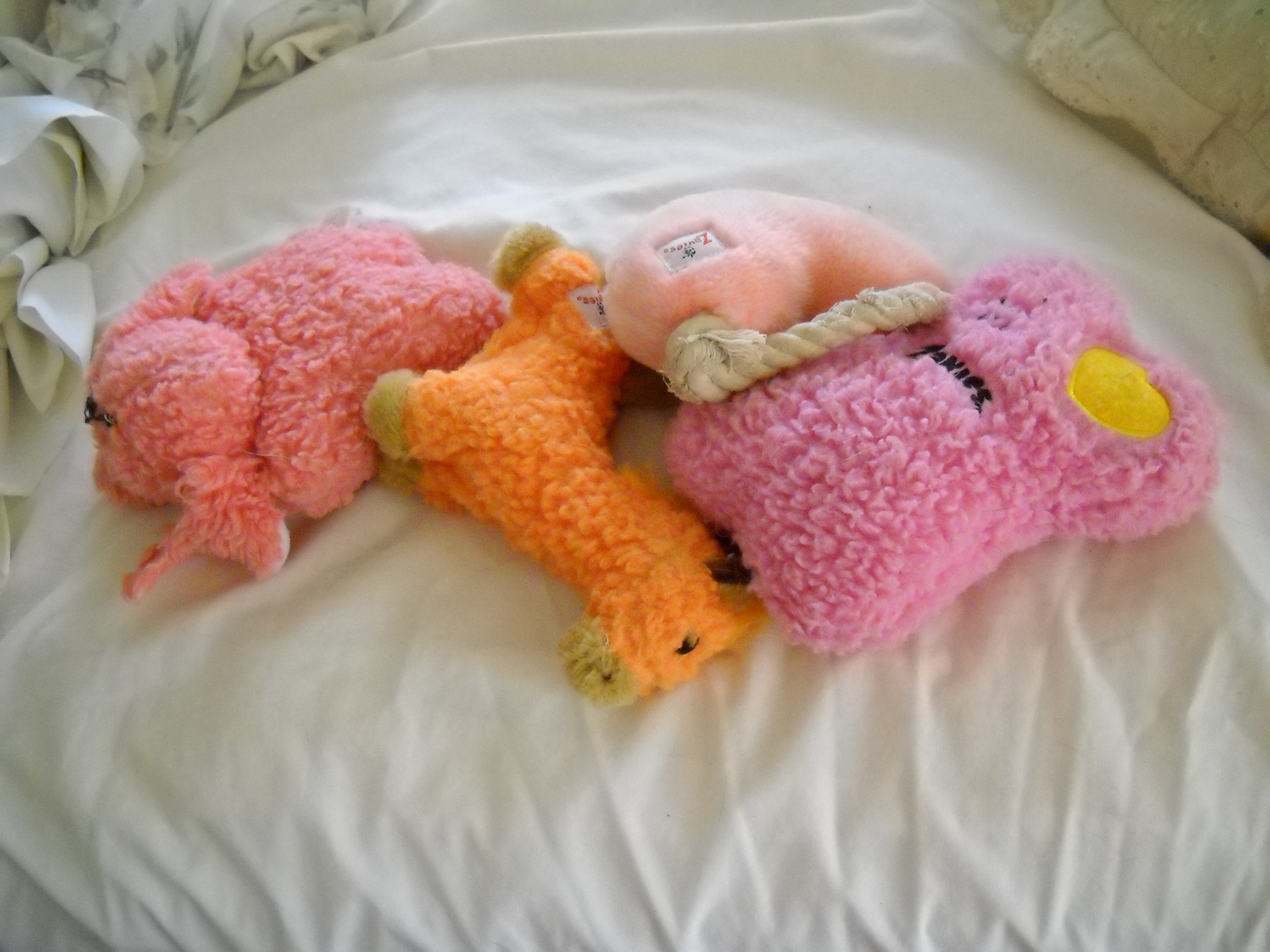
Sometimes she arranges them, always the pink ones, on the floor and most times on her bed.  Apparently, pink is her favorite color, as she always chooses that color from her toy box. The color choice surprises me, because I had always heard that dogs were colorblind.

She may not be able to control anything else in her little world, but she can control the order of her toys!

DSCN1281

DSCN1307DSCN1326I could find no information on any other BC exhibiting this behavior, so thought you might like to see pictures of Julia’s toy arrangements.

The intricate way in which she intertwines her toys reminds me of a jigsaw puzzle.

Four years ago, I found her at an abandoned ranch near me when she was approximately a year old.  She was  starving  and heart-worm infected, trying to dig water out of a dried-up pond. That was on the 4th of July, hence the name “Julia.” She’s the best thing that ever happened to me.

5205096764708059358We began Agility training and so far  she has added five titles to her name!

Click to learn more and buy!

Click to learn more and buy!

Editor’s Note: Julia’s artistic arrangements are reminiscent of Dog Works: The Meaning and Magic of Canine Constructions by Vicki Mathison.

Finding Mick, Part 2

All the Circles

by Lisa Lanser-Rose

Don't go.

I’m not leaving.

“I’m not leaving.” I grabbed my daughter Delaney’s hand. I felt a wave of relief. We’d have our last three weeks together after all. For three more weeks, we’d share the same roof, walls, and floors, the same briny wind through our windows, the same pot of coffee, the same mailbox.

Now, I had only one challenge: how to tell my mother she’d bear her unbearable burden alone after all?

A horn blew in the front drive, and we jumped to our feet. My old Border Collie Casey stood up with us, clattered sideways, then steadied.

“You should go,” Delaney said. “Rose or Rick can help me take her to the vet in the morning.”

If Casey’d had a stroke, what could I do anyway? “She doesn’t seem too bad,” I said. I frowned, otherwise I might weep all my eye makeup off.

Again, the horn blew.

“It’s okay, Mom.” She hugged me good-bye. “I got this.”

IMGP1274

As if there was no threat to any loved one anywhere.

Then an airport shuttle swept me away and noodled me around neighborhoods, idly collecting more passengers as if there was no reason to hurry, no threat to any loved one anywhere in the world. Eddying along, shoulder-to-shoulder, the others made small talk, but I was curt. “My dog is sick.” They stopped talking to me. Could they tell I’d thought about hijacking the car? Did they condemn me for abandoning my dog and daughter? Or did they secretly sneer at me for worrying over a mere animal? I glared out the window.

At the airport, I texted Delaney for news. My colleague, Rick, had promised a ride to the vet the next morning. Casey was the same. I tried to shake it off, but the broken way she moved and the unnatural tilting of her head reminded me of my first Border Collie. Epilepsy had killed her in a manner that still chilled the pit of my stomach.

Or did blood ties trump the bond with my dog?

Did blood ties trump the bond with my dog?

How could I put three thousand miles between my responsibility and myself? Was I letting my mother’s needs override my own? Or did blood ties trump the bond with my dog? Perhaps I’d just banked on the characters who’d live—the dog and the man were checking out, so I was just going where I was needed most. Delaney had our friends to help her, but my mother had been tending her husband and his cancer for two cruel years. She was at the end of her emotional resources.

As we merged onto the highway toward the airport, the panic subsided; my chest petrified. I boarded the plane and allowed my stony self to hurtle westward, Tampa to Atlanta, Atlanta to San Francisco, eight hours of mental cement. On the ground  in San Francisco, I texted Delaney, “You still up?” No answer.

I looked back, southeastward.

I looked back, southeastward.

I was buckled into another shuttle. It was well after midnight, and the driver shut off the interior lights in the bus. When we crossed the Golden Gate toward Sausalito, we exited the bank of fog straight into the Milky Way. I looked back, southeastward, the way I always did, to lose myself in the lights floating on the invisible hillsides, suspended in the sky, and winking in the bay.

I knew then why I had left. My dog was dying. My daughter was leaving. I was unmoored.

My mother picked me up at the shuttle depot and carried me in her car. I checked my cell phone—still no word from Delaney. When we arrived at the house, the hour was after two in the morning. The sprinkler system sizzled through the night garden, sputtering with the scent of wet soil and grass.DSC02252

The security system beeped as we opened the door and rolled my suitcase rumbling and bumping over the stone tiles. Golden lamps cast soft, mustard-colored shadows on oil paintings of Italian landscapes and glinted on plates glazed with painted-fruit patterns. A glistening ceramic rooster lorded over the great room, silently crowing while a television flickered and mumbled.

There, my stepfather sat waiting up for us. He rose from his recliner to greet me and stepped into my arms. It surprised me how small he was, this man who had been kinder to me than any other man I had ever known.

“I’m still here,” he said, his voice unnaturally soft and hoarse. “I keep thinking, ‘This is it’ . . . then I wake up, and I’m still here.” He sounded disappointed, like a man eager to take out his new sailboat, but every day it rained.

I’d never met anybody who wanted, so candidly, to die. Following his tone, I might have said, “Oh, I’m sure it’ll happen any day now.” I could have elbowed him and quipped, “Isn’t there something you can take for that?” I might have  puffed on my Groucho air-cigar and said, “The suspense must be killing you.”

Instead I said, “John, you must feel awful.”

“That’s right, Lisa. I do.” He eased into his recliner. “I do.” He rested a moment, catching his breath. Then, more softly, he said, “There are circles, and if I . . .” He frowned around the effort of making himself clear. “All the circles . . . come to the center, and I have to find . . .” He cocked his head and looked up at me. “You know what I’m saying?”

I didn’t know. I nodded.

Mom and John-001

John and my mother.

My mother brought two glasses of Sangiovese, John’s favorite wine. “The blood of Jove,” my mother said as she handed it to me. I looked around for John’s glass. The last time I visited, we three tipped many a glass of Jove’s blood together. This time, John couldn’t swallow—he had esophageal cancer and was starving to death. My mother sank beside me into the white leather sofa and caught me looking for the third glass. We clinked our glasses together and didn’t cry.

For a few minutes, we sipped our wine and watched John drift in and out of sleep in his reclining chair. My mother said, “You want to go to bed?”

“I’m still wound up.”

“Me too. I haven’t slept in years.”

She led me out on the patio without turning on the light. We sat on the swing together. My mother tends to be aloof, not physically demonstrative, so the intimacy of sitting together on the swing made me alert and oddly happy. We rocked for an awkward moment, and then she said, brightly, “John says he’s going to another planet.”

“Cool.” I nodded even though she couldn’t see me. “Kind of a wormhole thing?”

“I guess.”

Swinging in the dark, I could barely make out the brushed white cement of the patio floor under our feet, the sunshade over our heads, or the wine sliding in our glasses, but I could feel everything.

As my eyes adjusted, I could see the shadows of John's work.

As my eyes adjusted, I could see the shadows of John’s work

She said, “John poured this concrete.” The property adjoined a nature preserve, and we heard frogs in the stream and bats on the wind. “He designed the sunshade. He raised and bolted the lumber himself.”

I knew all that. She wasn’t informing me, she was inviting me into her twilight, a state of gauzy marveling over the seam between what is and what will never be again. I felt the existential injustice—what stays and what vanishes isn’t fair. Scrap the sunshade. Let us keep the man. We rocked in the dark on the swing and shared the teetering terror between forgetting and remembering.

As my eyes adjusted, I could see the shadows of John’s work. We were facing south. Sitting there, in the dark, something pulled me southeast, as if my left hand might reach out and lay itself on my daughter’s head. Then I remembered how far away I was and felt a kicking panic, adrift in a sea of space.

Would I ever lay my hand on my old dog’s head again?

stars

All the circles.

Image

Have You Hugged Your Best Friend Today?

thanks buddy

Finding Mick, Part 1

Mother, Daughter, Dog

by Lisa Lanser-Rose

The California Clan and I

The California Clan and I

For twenty years, I meant to head west. When we got to California, we could live the way human animals were meant to live. Blood relatives would belly up to our Thanksgiving table, wink, and joke that they didn’t feed my dog underneath. Women with my eyes, cheeks, curls, and hips would push grocery carts alongside mine. When my daughter walked on stage for a school recital, she’d look down into the eyes of kin looking up. They would single her out and smile–because she was theirs.

Even though I suffered the absence of kin as a kind of chronic illness, I had turned my two-human, three-species household into the happiest life I’d ever lived. I had about three weeks of it left when my mother called and asked me to come to California. She needed help taking care of her husband while he died.

She’d never asked me for anything before, so I said okay.

That meant my daughter and I scrapped our big plans for the last weeks of our last summer together before she left for college. Instead she’d spend that time at home alone with no one for company but our ill-tempered cat and our creaky old Border Collie, Casey. It hurt. Delaney and I were tight, the way some single moms are when they have just the one kid. Now our intrepid duo was coming to an accelerated end that I couldn’t picture for myself. I could picture it for Delaney—she’d order cheap pizza with her college roommate, pull all-nighters, plan flash-mobs on campus, lug clothes and quarters down to the laundry, screen zombie movie marathons in the common room. I’d made sure she had all the pencils, pajamas, and posters she’d need. As for me, after I helped her move into the dorm, I had nothing on my calendar.

_SC01443

The most beguiling ratios.

After six o-clock on a Friday evening, Delaney scooted aside so I could lug my suitcase past her. Casey, who used to rocket out ahead of me, lumbered behind me down the stairs. Delaney’s laptop lit up her face with the bright gray light of a hurricane sky. At eighteen, she was beautiful in the way of great beauties—her face had the most beguiling ratios of cheek-to-chin, eye-to-nose, and brow-to-lip, the kind that not only made people stare, but made them blurt out, “I’m sorry, but I can’t stop staring.” She looked nothing like me.

“We’ll Skype,” I said. “We can text while I’m at the airport.” I rolled my suitcase to the door. Casey came with me.

Casey’s pedigree said she was my dog, and so did she. For fourteen years I fed her, I trained her, I threw her Frisbee, millions upon millions of times. Casey was mine. If we ever did battle for custody of Casey, Delaney could’ve introduced into evidence a home video: four-year-old Delaney stands holding a puppy in her arms, whom the record will show was Casey at eight weeks. In it, you can hear my mommy-voice utter the incriminating line: “How do you like your new puppy?”

I gave Casey to Delaney because I wanted a daughter who wanted a cool dog like Casey as much as I did. That’s because when I was a little kid, even as young as four years old, I would’ve done anything to live side-by-side with a dog like Casey. But maybe Delaney was too young, or maybe Casey came too easily, or maybe Delaney’s brain was wired for feline. To her the dog was more conflict and competition than companion. A dog like Casey was in her way. A dog like Casey was my way.

Inter-species sibling rivals.

Inter-species sibling rivals.

And Casey knew it. While Delaney was growing up, Casey chased her and her friends through the backyard, staggered around the house wearing a princess gown, and let herself be tucked into My Little Pony bed sheets because I willed her to do it. Casey “keeked,” a term Donald McCaig picked up in Scotland from a shepherdess named Viv Billingham, “Tell me, does he turn his head back to you, looking for instructions? Keeking, we call it.” Casey keeked not to Delaney but to me, as if to ask, “You want me to wear this tiara? Oh, okay. I’d rather not wear a tiara while running a lawn-chair obstacle course with the kids, but if you want me to do what the kids want, okay.” If I’d beckoned, she’d have bolted to my side.

Every night when Delaney was still little, I pointed to the end of her bed, and Casey pointed at the door. She glanced back at me, not keeking but negotiating for a promotion—bedding down in my room. Resigned, she curled on the end of my daughter’s bed, always slightly panicked to see a door close between us. She’d lift her head one last time and then lower it, as if to say, “You sure? Okay, one more night.”

Finally Delaney grew into a teenager.  “Casey bugs me jumping on and off the bed while I’m trying to sleep.” And so Casey got her bedtime upgrade.

A family counselor would say the three of us—mother, daughter, dog—were “enmeshed.” Casey was the closest thing to a sibling my only child ever had. I had a lifelong case of  dog-aholism, and the three of us were deeply co-dependent—or is that “co-reliant?” Not a competitive sort, I didn’t see Border Collies as tickets to big sheep-trial purses, agility trophies, or rescue-network sainthood (even though I secretly craved and liked to think myself capable of all three). Nor was Casey the object of my otherwise unspent maternal excess—she was just my dog, which for most of us should be enough of a mighty thing.

Casey and I.

Mental fusion.

If neuroscientists ever studied Casey’s brain and mine, they would find mental fusion, mirrored neurological roots and branches twining and grafting. My brain had a caniculus or a “little dog” of Casey like the homunculus or “little man,” the neural map of my own body. After fourteen years of bonding with that dog, the Casey-region of my brain was especially large—never mind the Delaney-region. That was probably an entire continent.

In the foyer by the front door, I tried to slide a couple keys off my key ring without breaking a fingernail or bursting into tears. I said, “I can’t believe I’m leaving my girls.”

“The last three weeks of my last summer at home too,” Delaney deadpanned, without lifting her eyes from her laptop.

“Thanks, kid. That helps.”

According to my flight itinerary, I’d be taking the red-eye alone to California and returning in three weeks. The oncologists had given my stepfather two.

“Here’s the car key,” I said, even though Delaney didn’t have her license yet. “Just in case. The little one’s the mailbox key.”

“I know.”

The Border-Collie Mindmeld.

The Border-Collie Mindmeld–“Throw It.”

Casey wagged her tail and with her eyes tried to bore through my brow the command, “You’re taking me with you.” She couldn’t read the tickets through her cataracts, and even if she weren’t deaf she wouldn’t have listened to my rationalizations. Suitcases triggered rapid-cycling manic-depression in her—maybe adventure awaited! Maybe abandonment. Her tail popped up, ears forward, toes tippy-tapping, then her tail tucked down, her ears flattened back, her feet rooted in front of the door. She blocked my path in an unspoken demand that I could feel in my bones. The Casey region of my brain busied itself trying to figure out how to take her with me after all. I opened the door, knowing she’d shoulder it shut—

But this time she clattered sideways and fell over. When she tried to sit up, her head seemed to swing loose on her neck. I thought, “She’s having a stroke!” I was so scared, I could’ve picked up and thrown the whole house.

I dropped on my knees. “Casey!”

At the bottom of the stairs, Delaney hunched over the keyboard engaged in a battle of wit with an invisible someone, someone she’d probably never seen, someone unrelated to us. She machine-gunned whole sentences and smirked.

“Laney! Something’s wrong with Casey!”

“Oh, my God,” she said. She kept typing.

Head dipped to the right, Casey’s eyes shifted back and forth, faster in one direction, as if watching someone swing a cat. “I’m serious, Lane. Something’s wrong with the dog.”

Delaney put down her computer and came to see for herself. Her eyes widened. “Are you still going to go?”

The longer I'm a mother, the more I love my mother.

The longer I’m a mother, the more I love my mother.

My mind scrambled over the grown-up calculations we hesitate to share with our children: how much would it cost to reschedule my flight? How much would it cost to see the vet on a Saturday? How much do you invest in saving the life of a fourteen-year-old dog? How sick can she be when two months ago the vet said she was healthy enough to live to be twenty? How often do vets lie to pet owners to let them enjoy happier last days?

My Casey-dog was dying, just as my father had died, just as my stepfather, John, was dying. Should stay with my daughter while our dog dies? Should I keep my promise to my mother and help her shepherd her husband to his death? What good would I do here? What good would I do there? How should I decide?

My shuttle was late.