Mean Dog, Part 3

Gimme a Hug

by Terri Florentino

It was time to call Bud’s previous family. I needed details about his past.

When a woman answered, I said, “Hi, my name is Terri, and I currently have Buddy.”

“Oh!” She tried to say more, but began to cry.

I took charge of the conversation. “It’s okay. I know you tried everything. It’s not easy.” I explained my involvement. “It would really help Buddy if I had detail about his past.”

“My husband and I got him as a puppy from a breeder,” she said, eager to help. “Things just weren’t right with him from the start, and we talked to her many times.” The breeder had refused to take him back and wasn’t helpful with training recommendations. Buddy was an unusually quirky Border Collie puppy who posed a unique set of challenges for her and her husband, none of which they were equipped to handle. Over the years they worked with various trainers, sadly, with no success. When their first child came along, they sought help from a new trainer in the hopes of building a successful relationship between the dog and their child. The new instructor’s training method did not suit Buddy at all—his behavior escalated out of control. “We were told that the only options left were rescue or euthanasia.” She began to cry again. “We were devastated. But we couldn’t trust him around the baby.”

“Of course not,” I said gently. “You did the right thing.”

“Do you think . . . is there any chance of managing his behavior? We’d really like to take him back.”

“Perfect! That’s my goal.” What else could I say? The possibility of finding Buddy another home was slim to none.

Now that I knew from his previous owner a training regimen had made him fearful of training, I confirmed it. Whenever I attempted basic obedience skills, he was adverse and dismissive. I was determined to help this dog understand that I would never cause him anguish or pain. He needed a total life do-over.

They say that when a dog needs a fresh start, change his name. In case using his name in a particular circumstance reminded him of an unpleasant experience, I decided to rename Buddy. Thinking the name should have a similar suffix to his previous name so as to ease with the transition into the new name, I decided to call him Tulley. The name Tulley is a nice Irish/Gaelic name that means Living with the Peace with God, which I felt apropos.

 DSCN0746Once Tulley became familiar with the “touch” technique, he wiggled with excitement when playing the “touch” game. I now needed to devise another technique that would promote closeness and trust. I observed that when he sat by my husband he pressed his head against his body. I decided that we would promote “hug,” offering treats and praise each time he pressed against someone. Since my husband was his person of choice, I recruited him to introduce the process of “hug.” Just like “touch” the game of “hug” became a joyful and rewarding task. No doubt the highly delectable treats were a motivator as well. Tulley also had a very high play drive that would helpful when promoting interaction with strangers. A game of “fetch” always gave him an opportunity for a positive experience. I was full of joy watching Tulley play “fetch,” “touch,” and “hug” with as many people as I could get to work with him.

I soon began brainstorming what I had to teach Tulley to get him back to his family. Their young child was a concern. It is impossible to teach a very young child how to be responsible with a dog—especially one that will bite. So, how do you teach the dog how to be safe for a home with a child?

Image

When you have a long haul ahead, remember

IMGP9398

Image

Conspiracy Theory

Conspiracy Theory


Humor courtesy of https://www.facebook.com/ILuvBorderCollies  “Like” their page!

Mean Dog, Part 2

The Touch

by Terri Johnson Florentino

Ed and Tulley (1)

I slowly stood up and backed away, careful not to alarm Buddy. As my friend and I discussed his background, I purposely ignored him, but watched his body language in my peripheral view.

His hackles went down, his lips went down, and the growling stopped. I even saw him glance at me. He seemed to want to approach, but was too afraid. A few other border collies were running about not paying any attention to him, nor he to them. “Let’s put him in the crate in my truck,” I said. “I’ll take him home and see what I can do.” Before I left, I got the name and  number of his previous owners.

We arrived to my home with no issues. I pulled into my driveway and opened the back door of my truck. To be safe, I had kept the leash on Buddy and left part dangling outside the crate. I took hold of the leash and slowly opened the crate.

He  cowered in the back, trembling, snarling, and bearing his teeth. I gently pulled on the lead and coaxed him out. He cautiously jumped out of the crate and stood motionless, paralyzed with fear.

Without any discussion and very little eye contact, I  gently gave him a tug, and he followed me for a short walk around.  He began to relax a little. I took him into a  large fenced area, leaving the leash attached to his collar. I’m fortunate that my Border Collies are used to me bringing home the occasional “outsider” to the pack and know well enough to keep their distance. I dropped the leash and let him move about on his own. One by one I introduced my dogs. He barely acknowledged them, and therefore they just left him to explore the yard alone. I remembered the first trainer’s warning, “This dog should never be around other animals.” I was not convinced. So far, so good.

The initial introduction with my dogs went well, so we moved inside. My husband was sitting in the living room watching television, and the other dogs were simply going about their business. I followed Buddy as he moved timidly from room to room. Once the tour of the house was complete, I settled in the living room to  give all the dogs time to adjust.

Everyone behaved. I decided to take off Buddy’s leash. I slowly approached, leaned down, and reached for the clasp. He swung around and bit me.

Surprised and bleeding, I ran to the sink to rinse my hand. I said nothing to Buddy. I didn’t want to aggravate him further. When I returned, I saw that after he’d bitten me, he’d gone to sit by my husband. He seemed to know that he’d done something wrong.

“We need to teach him how to touch our hands,” I said. “If he learns to come to us on his own terms, maybe he won’t feel so threatened.” My hand was still bleeding, so I wrapped it first, then came back in the living room with liverwurst.

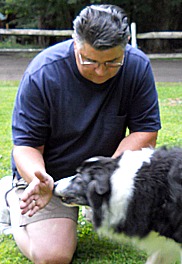
I gave my husband a few pieces of liverwurst. “Hold your  palm out flat, and when he touches it with his nose, reward him with a piece.”

“You’re kidding, right?”

“I want him to want to touch your hand. Hold still.” I smeared some of the liverwurst directly onto his palm. Fortunately Buddy seemed to have a high food drive. He touched my husband’s hand gently and got rewarded with the yummy food, My husband kept all his fingers.

Buddy learned this technique  right away and seemed to enjoy working with my husband. But he’d only been in my home a few hours and had bitten me good. Now what?

Image

Got plans?

DSC06805 (1)

Mean Dog, Part 1

Nap time

Nap Time

by Terri Johnson Florentino

I received a call one day from a trainer in a neighboring state. He said he had a three-year-old Border Collie that needed to be rescued. “Can you help? Over the last year, he’s gotten aggressive with his owners, their children, and other animals. He’s bitten a few times.” The owners were wonderful people, he said. “They’re heartbroken.” They felt that they had done all they could for the dog. “They’re afraid euthanasia’s the only option left.”

When I rescue, I bring the dog to live in my home with my family and other dogs. I spend a few months getting to know and training the dog. I aim to place the right dog with the right family. Everybody wins.

This trainer and I talked for a long time, and then, with a heavy heart, I declined to help this dog. How could I possibly put my family and other dogs through the stress of living with such an aggressive dog? I feared for his fate.

About a week later I took my Border Collies to my friend’s farm to work our dogs on her sheep together. After we were done, she asked me to spend some time with a dog that she’d recently taken in. “His name’s Buddy,” she said. “He came from an excellent home but he’s got some behavioral problems.”

She came out of the kennel with a beautiful, traditional black-and-white Border Collie. He followed reluctantly on the lead with a deer-in-the-headlight look. As I slowly approached, not saying a word, Buddy got increasingly uncomfortable. He averted his eyes, and his body stiffened. I bent down next to him. He took a deep breath and let out a very long growl. His beautiful coat stood completely on end, and his lips curled so tightly, he was bearing every one of his teeth.

And yet, I didn’t feel threatened. He never made eye contact, nor lunged to bite.  I felt sympathy for the dog. His display seemed to come from fear and pain. I turned to my friend. “Where did you get him?”

Sure enough—Buddy was the same dog the trainer had called me about earlier that week.

Why did this dog keep coming to me? What would I do? What would you have done?

Comment & Stay Tuned…..

For Mature Audiences Only

An important public health announcement:

IMG_2731

“You know it’s true!” –Mick.

Anthropomorphism?

by Terri Johnson Florentino

It’s said a picture says 1000 words, but this picture seems to have said so much more.  John Unger’s picture of him tenderly floating his aging and arthritic dog Schoep in Lake Superior became an instant Internet sensation in 2012 and resurfaced recently upon Schoep’s death:

Untitled1

So what is it about the human-animal bond that so intrigues us? Is it our inherent desire to love and comfort? Do we believe we are better people if we allow ourselves to feel the unconditional love of an animal? Does it help us to feel better about ourselves when we help an innocent creature? Is that why it’s often said in canine rescue, “who saved who?” At what point  do we put too much pressure on our pets to comfort us? Are we guilty of anthropomorphism, or the projection of human motives and behaviors, when we feel loved by and loving toward animals?

So tell me, what word comes to your  mind when you look at the picture of the man with his dog?

Border Collie Godfather

Leave the cone,

IMG_2692

grab the caterpillar!

IMGP9401