Author Archives: terriflorentino

Dangerous Chase, Part 5

GOING TO COURT

by Terri Florentino

courthouseCourthouse Square is always a great place to train and socialize dogs. It’s a bonus that there’s a lot of green area to spread out for basic obedience exercises and a fairly level sidewalk to practice heel positions. There’s never a lack of people, adults and children alike, sitting on park benches, strolling along pushing babies in coaches, skateboarding, jogging, and even walking their own dogs. The water fountains spout and splash water onto anyone that dares stand near enough, and there are various statues of heads of state strategically placed throughout the square. There is the usual hustle and bustle of traffic and the sounds of beeping horns, emergency vehicle sirens screaming as they speed past, screeching breaks, and the occasional rusted-out muffler growling as an old car passes by. There’s also the occasional beep-beep sound from the traffic light that signals when it’s safe to cross the street.

As always, I arrive a few minutes early. The class and I meet underneath the statue of George Washington. It was a beautiful day, warm enough that the thought of spending most of the class by the fountain crossed my mind. As the students arrived, we all engaged in small talk as we waited for the remainder of the students. As we were chatting about our week, I observed a young man on a skateboard pass by. At the same time I heard a shriek to my right and noticed Debbie bent over with her hand on her calf as she was reaching out to give Chase’s leash to her husband Sam.

“Are you OK?” I called out as I hurried towards her.

img_5168“He bit me! As the skateboarder passed us, Chase got so excited he turned and bit me on the leg!”

“How badly did he hurt you?” Deb pulled up her pant leg to assess the bite wound. “It’s a pretty good bite, but barely bleeding, I’ll be OK,” she said, obviously frustrated.

“You’ll need to be more aware of your surroundings and what might stimulate an overreaction from Chase. Next time the skateboarder comes by put Chase in a down/stay position and don’t let him up until the skateboarder’s out of sight. No doubt he’ll come around again, so be prepared. In the meantime let me take Chase for a few minutes while you calm down.” I took the leash from Sam so he and Debbie could take a few minutes to settle down.

img_5144Once all of the class arrived I announced that we were going to start with our walking exercise. “Let’s stay in a straight line, keep a reasonable distance behind the dog/handler team in front of you and rehearse a heel position while we walk. Are your dogs sitting politely on our left side? Remember to use your lead leg. Let’s go. Heel.” In a single file line we walked around the square, everyone promoting a good heel position even amongst all of the distractions. I purposely had Chase and Debbie walk at the end of the line to allow enough distance between Chase and the next dog. After a short while walking Chase, lunged at the Schnauzer in front of him.

“Leave it,” Debbie insisted with a firm voice, at the same time walking off with Chase in the opposite direction in order to relieve the pressure. Once Chase settled she fell back into line.

“Nice work, Deb,” I encouraged her to keep up the good work.

Once we arrived at a large green area, I had the class stop and take a break. “Great job with the heel positions! Get yourselves and your dogs some water and relax for a few minutes.” I sat down with my own bottle of water and admired all of the students enjoying their dogs.
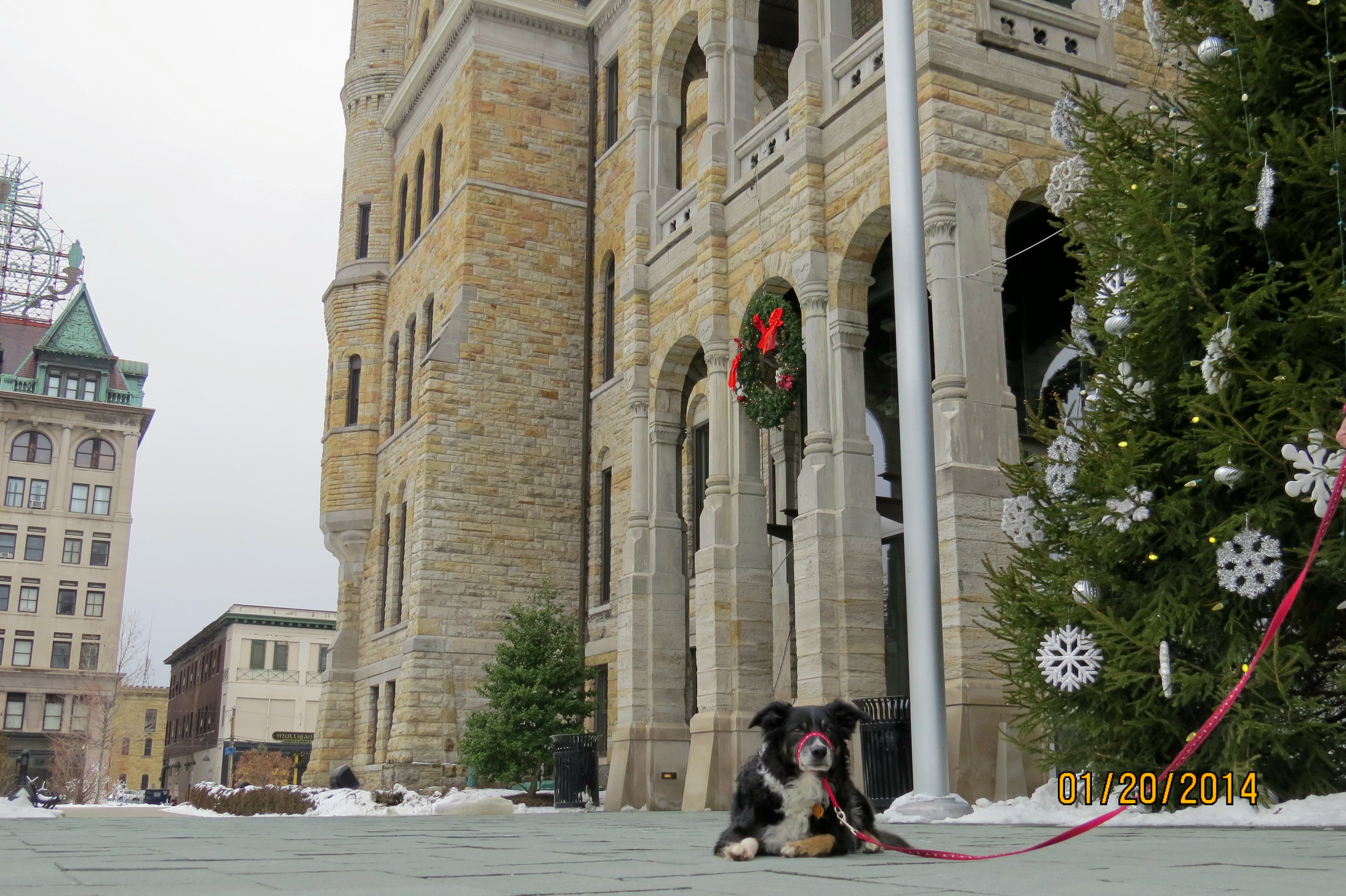
img_5142“What we’ll do next, right here in the green area, is practice the sit/stay and down/stay exercises. I’ll just have everyone spread out into a long line facing me. Put your dogs in a sit and stay on your left side, instruct your dogs to “stay,” and pivot in front of them. When we release them from the stay, remember to use the release word, ‘OK’.” We continued with these exercises for a few times, having the dogs sit or down while learning to stay. Debbie and Chase did very well; she was starting to recognize his comfort zone.

“The final exercise for the day will be at the water fountain, it’s always a lot of fun for the dogs that like water.” In a single file line with adequate spacing between each student we made our way around the block to the fountain. The water fountain is ground level, easy for the dogs to have access to walk on. One by one in a heel position the dog/handler teams made their way back and forth by the fountain. Most of the dogs didn’t mind the spray from the water, those that did stayed further away. As Debbie and Chase waited their turn in line Chase snarled, growled, and lunged at a keeshond that was standing in front of him. The keeshond immediately turned around and snarled back defensively. Debbie immediately removed Chase from the line while the owner of the keeshond settled him down just in time to go ‘play’ in the water.
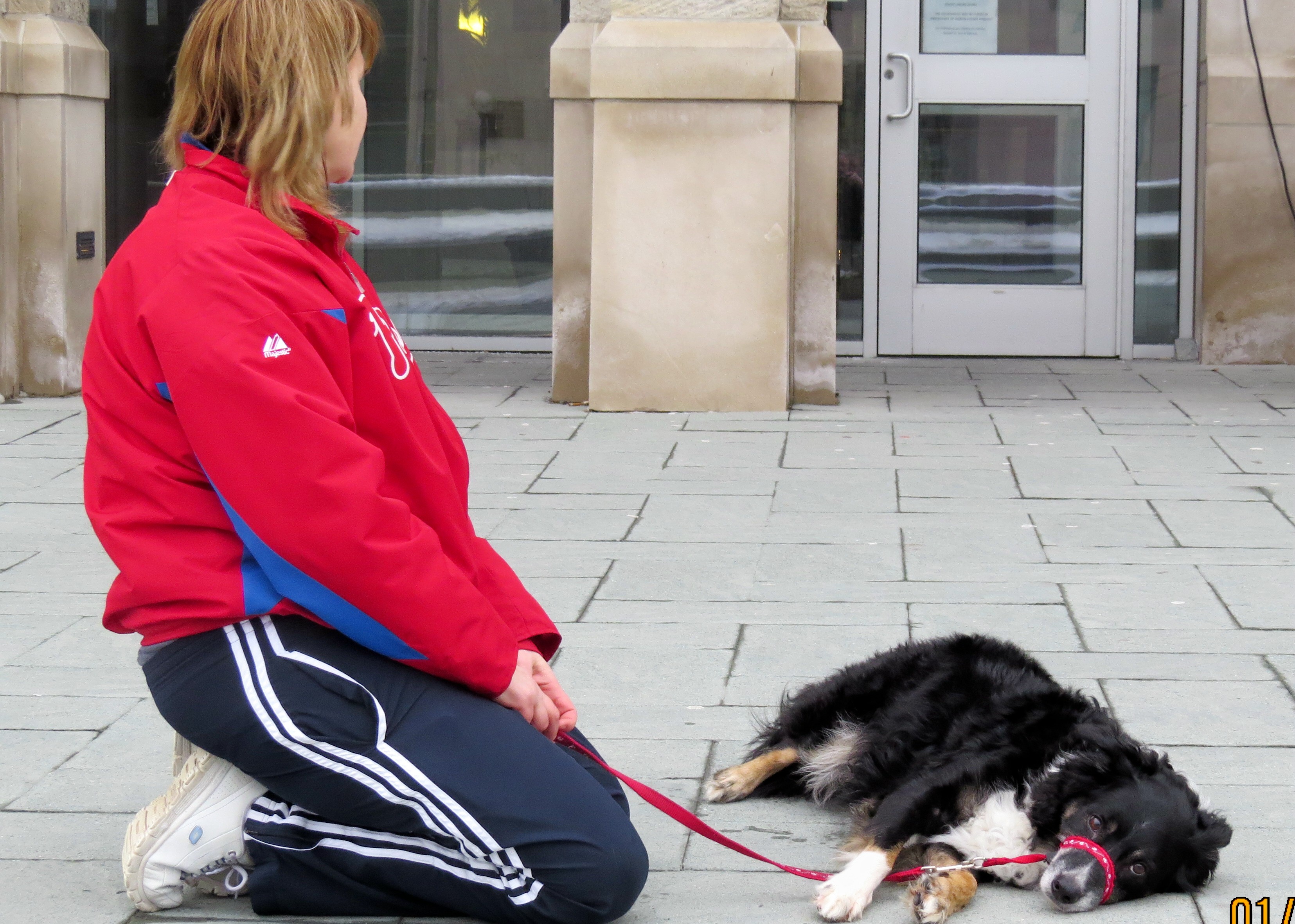
img_5155Deb walked far away from the group; I could tell she was upset. I finished up with the rest of the class. We discussed where we were going to meet the following week. “Congratulations, you’re all doing a fantastic job with this class; I’m looking forward to seeing all of you next week.” Once the students started to walk away I made my way to Debbie and Chase. By now Debbie was in tears.

“This was a terrible day,” she sobbed.

“You did a very good job today. Each time Chase overreacted, you handled him perfectly. There were even a few times that he didn’t react at all. You’re not going to magically make his reactiveness go away overnight. He’s learning from you that his responses are inappropriate, and you’re working very hard at promoting appropriate interaction. Go home, give Chase his favorite learning game and relax, you’re doing fine.”

“Some days I think we’re really coming along, and then days like today I feel like we’ve made no progress at all,” Debbie sighed.

“Keep at it, Deb. I assure you he’ll come around. Sometimes it gets harder before it gets easier.”
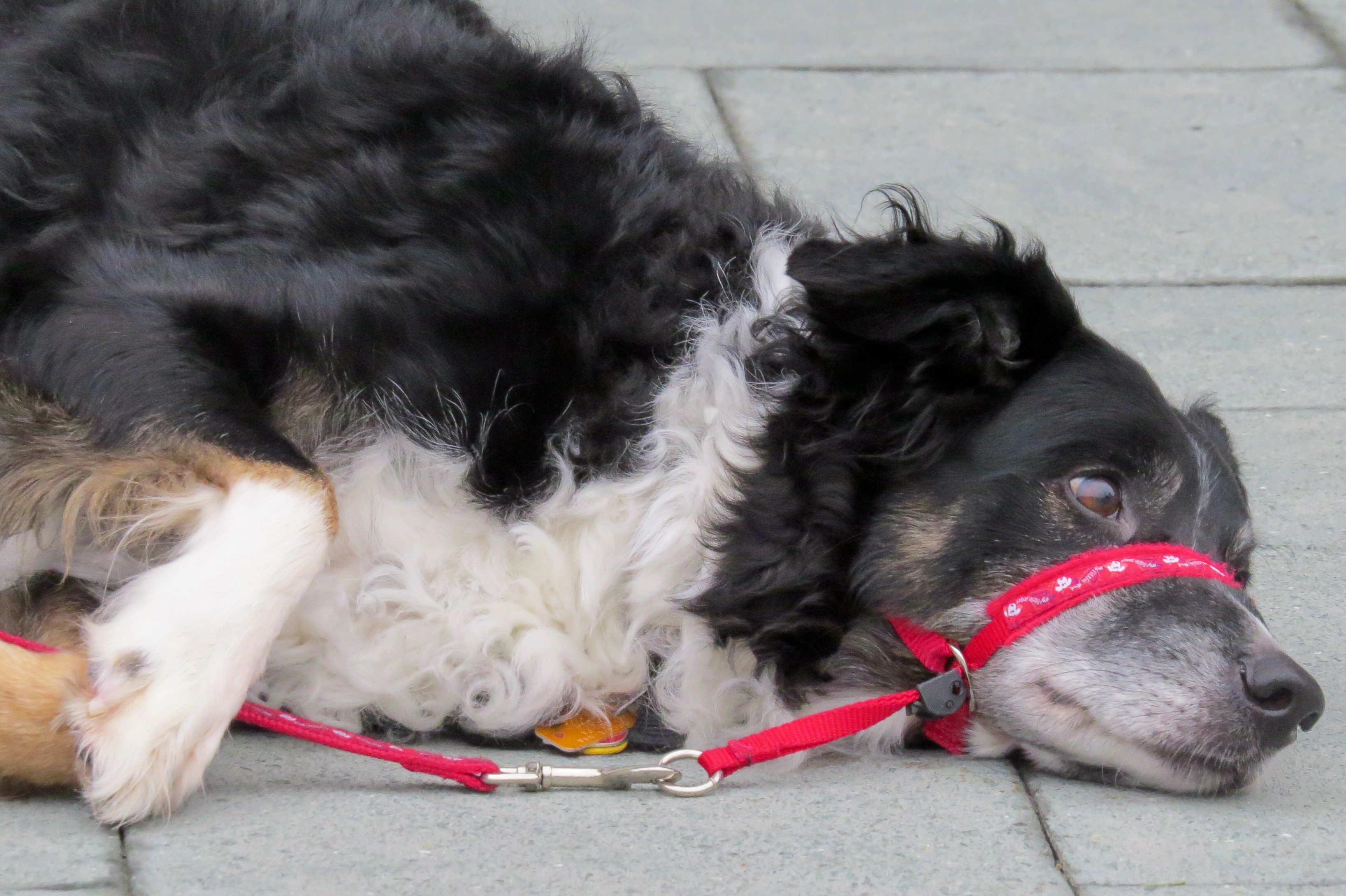
img_5156I bent down to Chase, who immediately rolled over onto his back. “You’re alright, Chase. Be a good boy for Debbie this week.” I gave have him pat on his belly, he wagged his tail, and we stood up and walked together back to our vehicles. “Keep your chin up, Deb. I’ll see you next week.”

As I watched them go, my biggest fear was that Chase might bite Debbie or Sam –or someone else–so severely that they’d give up on him. And then what would become of Chase?

The Pack, Part 1

They Lost Their Pack Leader: Now What?

by Terri Florentino

pack

Terri and her pack.

I never bought into the theory that I had to be the dominant leader of my dog pack. I never saw myself as such, nor did I ever feel the need to attempt to “act” like my dogs in order to communicate with them. Yes, I spend time individually training my dogs, feed them, groom them, socialize, exercise, and love them but I am not their “pack leader.” Yes, humans have domesticated the dog, but to what degree?
I have lived with many dogs, at least five at a time, over the course of fifteen years, and can tell you that there appears to be a pecking order within their own ranks. I’m not sure why we would believe otherwise. We humans fall into similar social hierarchies. For instance in sports, doesn’t every team have a coach? Most social animals do. It seems to be natural for any pack, pod, or flock animal—consider the very phrase “pecking order,” which comes from watching chickens.

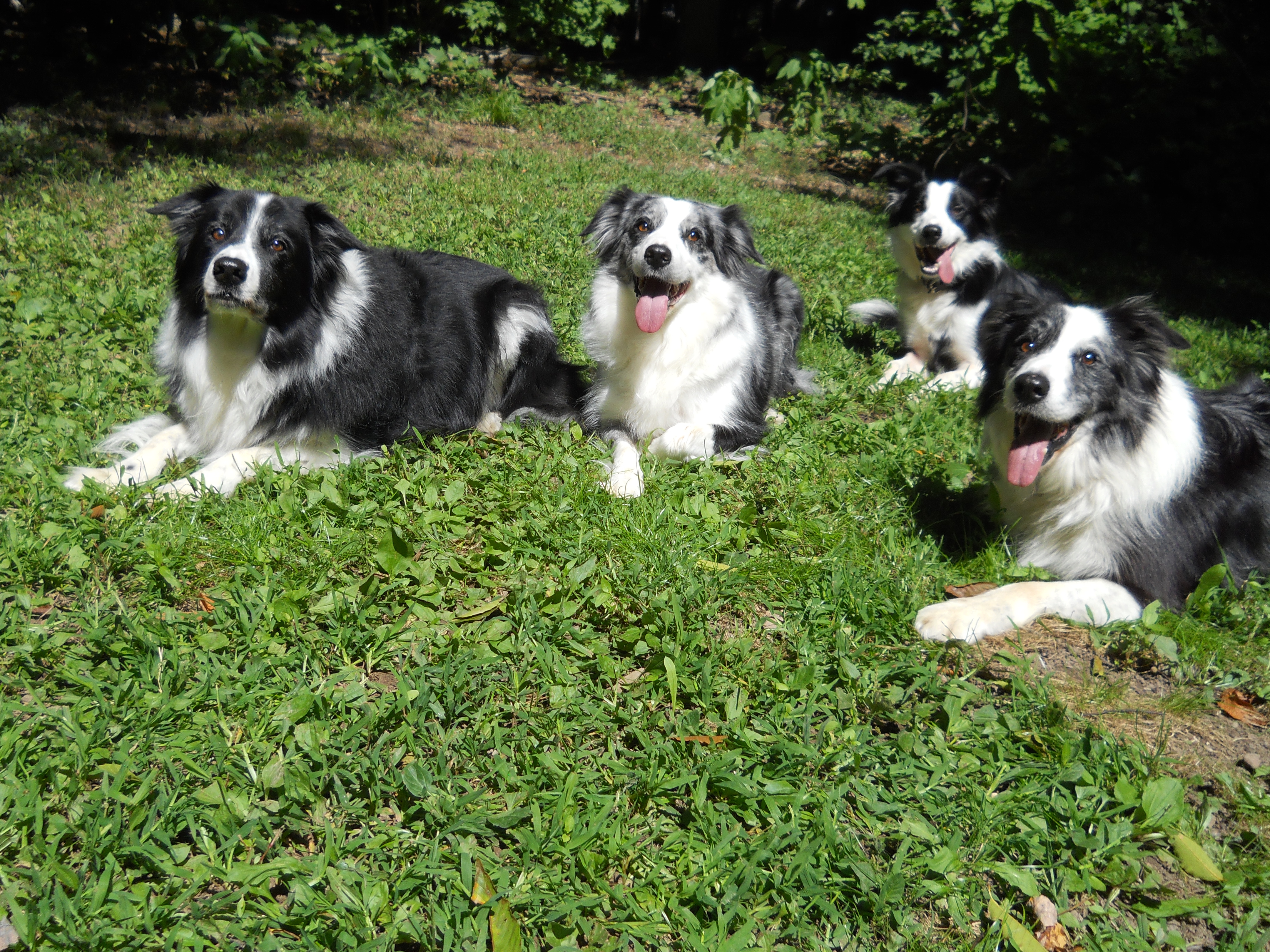
Tulley, Echo, Mirk, and Roy, who was just visiting.

l. – r. Tulley, Echo, Mirk, and Roy, who was just visiting.

What actually constitutes the definition of a pack leader, within a group of domestic dogs? We know that for a pack of wolves or coyotes it’s all about survival, so we can appreciate the importance of a strong hunter.

My dogs have never had to fight for food. I know of puppy evaluations where a piece of meat is thrown to a pack of seven-week-old pups. Whichever pup “guards the meat” is one that the breeder might be very interested in keeping for its dominant temperament. So does the display of a survival instinct define a leader? Perhaps a leader is determined by the tendency to discipline other dogs for inappropriate behavior, in effect, to govern them? How about the drive to ward off strangers? Perhaps the ability to charm humans into doing their bidding might be the real and true mark of a canine pack leader. I’m often amused at how often some dogs have their owners so well trained, and the owners don’t even know it.

As of last week, my family and I lived with seven dogs.

Heather and her soul-dog, Epic.

Heather and her soul-dog, Epic.

After careful examination and an abundance of medical testing it was apparent that my old girl Epic had developed a bleed in her brain. There was no turning back. My daughter Heather and I knew that we had to let her go.

Epic had chosen my daughter Heather as “her person” soon after we rescued her from a hoarding situation. Heather trained her, competed with her in obedience, and became her bed bug at night. In the vet’s examination room, Heather cradled Epic in her arms, inconsolably sobbing. I held both Heather and Epic, reassuring Epic that she was a good girl as the doctor gave her the final injection. Epic took her last deep breath and was gone. She lay peacefully in Heather’s arms until Heather was able to let go.

Now the mourning and healing for the human family would begin. But what about the other six dogs?

Sweet Epic has left us.

Sweet Epic has left us.

A bewildered uneasiness had fallen upon our pack. Epic had been the matriarch who commanded respect. She managed all of them with strong-willed peacekeeping diplomacy. She was a guardian, the greeting committee to the countless rescued dogs who entered our home, an “Aunt” to the occasional litter of puppies, teaching them right from wrong. Any dog who had been under Epic’s regime would greet her by laying down, rolling onto their back and licking her mouth, even when she’d reached the fragile old age of fifteen.

Scout

Scout

Now our pack consists of Scout, who, at nearly sixteen, is the oldest of them all. Next is Deja Blue at fourteen, Tulley at a youthful twelve (He was featured in the “Mean Dog” series in BCI), Mirk, age eleven, Echo at seven, and young Wyn of five years. Scout has always been the family pet, too old to care about leading the pack.

Deja, Mirk, and Echo

Deja, Mirk, and Echo

In her day, Deja was a tough lady, a talented sheepdog with too much of an independent streak. In her “hay day,” I suppose I might have thought her the next pack leader, but she now prefers to be left alone to sleep comfortably on her bed, next to mine.

Most of the dogs defer to Tulley, but he has no interest in the pack behavior unless it has to do directly with him.

Mirk at work.

Mirk at work.

Mirk was born here (Deja is his Dam) and lived with us for the first year of his life. Then he went off to pursue a professional sheepherding career. Over the course of the last ten years, he would come home on occasion. Just a few months ago, he retired and is now home for good, and the pack is still adjusting to him. He does have a very strong presence within the group, but strong enough to step up to the role of leader?

I love them all, but my heart and soul is Echo, a younger full sister to Mirk–she finishes my sentences. She’s not one that stands out as a leader, but she is well balanced within the pack and will step up to control any improper conduct with the other dogs. It’s said that the best leaders rule with a velvet glove, so maybe it will be Echo?

Will Wyn be the Winner?

Will Wyn be the Winner?

The truth is, I always thought that Wyn, a daughter of Echo, even though the youngest of the pack, would be the next leader. After Mirk she is my most talented sheepdog, by far the most boisterous and always into every other dog’s business. She may be too much of a busybody to rule the pack.

Either way it will be interesting to see how the dynamics of my pack eventually play out. For now, we’ll let nature take its course.

Wee, Part 5

An Explorer Extraordinaire

by Wendy Drake

After I spent a day in Cooperstown meeting relatives who’d known my grandfather, many more side paths tempted me. I wanted to know more about these new-to-me relatives, Hugh and Eleanore. Eleanore also played piano and had learned from my grandfather’s sister, Lucy. I wanted to spend more days at the Inn at Cooperstown, which had been the Cooke (my maiden name) family home from 1893 – 1974. Further, Charles’ book held themes, which resonated for my running.

Charles had compared piano practice to being fanatic about healing fractures. Using a bone healing analogy throughout his book, he suggested bracketing the portions of a piece of most frustration to a pianist, practicing them over and over, until mastered. Years may pass, he acknowledged, but the pleasure derived in the process and the strength of the bone at the fracture make the whole piece stronger than it ever would have been without the work.

After healing from three fractures in my feet and many shredded body parts from tripping and falling on trails, I understood that, with work on specific weaknesses like downhill footwork or running uphill, I could get stronger and stronger in my running. After failing to find a path with the letters so many times and continuing to practice with them, I felt my story becoming stronger. I also felt a connection to Charles through my practice. I wondered if Louise had this lifelong relationship with her piano playing as well. I wanted to indulge the endless side paths to which I was being introduced.

While I didn’t want to leave Cooperstown, a puppy awaited my arrival. I reluctantly retreated from these new paths to proceed onto the one I’d planned. It was time to meet Terri and the team of people who surrounded Wee with infinite puppy love. As the miles increased on my journey toward Wee, so did my excitement. By the time I met Terri, I could hardly wait to meet him. When I finally did, he seemed as eager to greet me as his brother Ace, who was twice Wee’s size.

The afternoon flew by too quickly. Terri took me to lunch with Megan, who’d cared for Wee with two of his siblings, Brea and Ace. We talked about the dogs. I wanted to know everything possible about Wee. Terri had checked every medical and behavioral box and more for Wee, her first runt. We talked about Megan’s upcoming wedding, the book Terri was writing, and mine too. She mentioned several times in passing a writer named Lisa in Florida. The depth of their friendship would not become clear to me until months later. Wee, Jorge, and I’d come to know her better through her border collie, Mick, who was two weeks younger than Wee. It turned out to be Mick who would have the unpredictable health problems I’d feared for Wee. While we would have our share of health scares with Wee, the biggest problem we’d have was keeping what came out the other end solid.

We plays with Echo and Brea one last time.

We plays with Echo and Brea one last time.

After lunch, we returned to Megan’s home for the beginning of tearful goodbyes, but not before a final play date between Scout, Brea, Ace, and their dam (mother) Echo. In a short twenty-minute play session, I took over ninety photos and a video. I didn’t want the day to end, but Wee and I had already scheduled his first adventure: a plane ride.

A last stop at the Veterinary Referral and Emergency Center (VREC) so that caregivers Ashley (left) and Jen (right) could say good-bye.

A last stop at the Veterinary Referral and Emergency Center (VREC) so that caregivers Ashley (left) and Jen (right) could say good-bye.

We made one last stop at the Veterinary Referral and Emergency Center (VREC) so that caregivers like Ashley (left) and Jen (right) could say good-bye to Wee too. Wee’s mom Echo also came along to say bon voyage to her youngest and smallest pup. Then it was time for Terri.

I doubt I could ever be a breeder. Letting puppies go over and over would be impossible for me. Because this pup in particular had worried Terri for weeks, it was especially hard for her to let him go. Is there ever love without worry though? I doubt it. Terri’s tears tugged at me, and I found myself wanting to ease any additional lost sleep.

“I’ll keep you updated. He’ll have a Facebook page as soon as we decide on his Colorado name.”

Wee at the airport.

Wee at the airport.

And just like that, the Wee pup became Mr. Explorer Extraordinaire. Terri helped me tuck him into the carrier, which would fit under the seat in front of me on the plane. Never would the Wee pup ever fly in cargo. I might have been more demanding on this point than Terri.

The first flight was short and uneventful. I expected some whimpering, but Wee had perfect manners. We arrived in Philadelphia and made our way through a crowded airport. Wee was a star everywhere. He was attracting so much attention that my good friend Jennifer, who goes by “Ifer,” couldn’t miss us. She’d been consulting in Philly that week. We collapsed into each other’s arms with hugs and girlie exclamations over Wee.

“Are you headed to or from Boulder?”

“To.”

On his way to becoming Scout, The Explorer Extraordinaire

On his way to becoming Scout, the most lovable Explorer Extraordinaire

After realizing we were on the same flight, Ifer hurried with me to check-in and upgrade her seat. I’d splurged in Pennsylvania at the airport for Wee’s first big plane flight to be extra special and we were flying business class. It paid off. The flight attendant not only kept Ifer and me giddy with red wine, but also instigated us to take Wee out of his crate for the entire flight. He wiggled around my lap and gave everyone kisses, something he still does today.

I don’t remember how we decided to give Wee the name “Scout.” I think I first heard the name when Terri mentioned one of her dogs, who was named Scout. Wee seemed to want to explore everything when he arrived home, so Scout Explorer Extraordinaire seemed a good fit. After we watched “To Kill a Mockingbird,” I was sure. Both Jorge and I love to go on adventures and we were hopeful Scout would go with us too.

In the year since he’s been with us, he’s documented all his adventures on his Facebook page, Scout, Explorer Extraordinaire. He never warmed my feet as I’d hoped when I wrote. I suppose those days may be ahead when Mr. Scouty boy mellows a bit and I make the time for the second book about the letters. We’ve had some rough spots where he was sick, once with kennel cough and a few times with things we never did figure out. He destroyed shoelaces (on our running shoes) and offered up a few baseboard corner casualties. Like Sadie’s those repairs will likely be de-prioritized for years. One of the most disappointing was being suspended from herding school. Scout had been doing well, but I’d not worked with him long enough on attention to give him a fair shot. When he bit a goat, Cathy, his handler, suggested he needed “some time.”

Scout did and does, however, accompany Jorge and me all around Boulder getting love and praise for his good behavior. At the post office, he’s allowed to “paws up” to the counter. We send copies of my first book, Running to Thousand Letters, about what happens when I open 100 of the 1,000 letters. He pokes around McGuckin, the local hardware store, for project stuff and obeys “lie down” for treats. He’s taken a few plane rides with us and had lots of training at the Boulder Valley Humane Society. He even goes to work with me now that I’m working in downtown Boulder at a startup. We stop at The Unseen Bean, a coffee shop run by a blind man and his canine helper dog. The Unseen Bean has Scout’s favorite treats and mine too: dirty Bhakti Chai (chai with espresso shots). That’s a treat for both of us as is running up Sunshine Canyon trail for our four-mile mid-day workout.

We still have yet to get Scout on regular long weekend runs with us. First, we have to learn recall together in order to earn his “Green tag,” granted for Boulder dogs, who’ve pass a program for good off-leash behavior. Terri tells me it takes a solid two years to get recall consistently. Scout does pretty well especially if I have the Chuck-It ball Megan sent for his first birthday.

Second, Scout continues to learn that biting our feet while we run is not cool. Both Jorge and I have learned new hopscotch-like foot moves when Scout goes for our shoes instead of running with us. Even so, his longest recorded run was thirty-one miles late this summer. For a few days after that run, every time we’d put our shoes on, he’d self-crate himself. I suspect we overdid him that day. It seems four-to-six miles is his preferred, non-meltdown distance.

The Wee pup’s story has a happy ending. From twelve-and-a-half pounds at the airport when we left, he’s now a healthy thirty-five pounds. Wee became Scout who is a classic Boulder dog, growing up outside and playing in the mountains. He asked for a GPS watch for Christmas. You can follow how that works out for him at facebook.com/explorerscout.

Wee, Part 4

My One and Only Online Crush

by Wendy Drake

Wendy had a lot of work to do.

The thousand letters.

And what an adventure Wee and I have had in our year together here in Colorado. I never would have believed it. Writing a book about unfolding 1,000 letters I bought at an estate sale in 1997 led to the joy of waking up every day to a black ball of fur demanding massages and kisses before he will get out his queen-sized bed. Guests sleep on the couch. Yes. Border collies are the smartest dogs on the planet.

In the Fall of 2012, I was deep into research for my book, Running to Thousand Letters. In 1997, on an impulse I’d bought 1,000 letters at Louise Palmer’s estate sale. Louise’s love of piano (it was her vocation) had triggered one of the many side-paths I indulged as I began unfolding these letters. The one I was following when I committed to adopt Wee was learning about my paternal Grandfather, Charles, a self-described amateur pianist who lived in Cooperstown, New York, less than a two-hour drive from Terri.

I’d also just begun training again for long distance running in the foothills of the

Wendy on the trails.

Wendy on the trails.

Rocky Mountains here in Boulder, Colorado, my home. For me there is nothing more fulfilling than a day on the trails. I didn’t start out being an endurance runner. I just wanted to be in the mountains, climbing to the top, looking off in the distance toward another end that is really just another beginning, and exploring new paths.

Even the trails couldn’t fulfill me entirely though. Something was missing. It had been almost two years since my seventeen-year-old fur-child, Sadie, died. She is a soul who will never leave me, the partner who lived longer than she should have, and one of a few beings who stops my heart because she left. I wondered if I could ever offer the love I had for her again.

Wendy and Sadie

Wendy and Sadie

It had been seven years since Freeway died in 1995. Freeway had been a border collie, so I had a good idea of how much exercise and how many tennis balls his breed would require. Among the most intelligent dogs, border collies learn quickly and it’s important to constantly keep their minds busy with new games to avoid spontaneously exploding couches.

I’d planned to adopt two thinking they could keep each other busy. Mostly though, I wanted dogs that would match my energy. They had to be able to run the thirty to forty miles a week on average (sometimes as many as fifty to sixty during peak weeks) I ran training for long distance endurance runs. They also had to have an “off” button and settle down when I sat down to write for four to six hours a day.

Sometimes plans are pointless.

I intended to adopt two- to three-year-old dogs and had seen what seemed like every single available border collie rescue in the prior six months.  So had all my Facebook friends. One, Brenda, connected me to Terri in Pennsylvania.

I wavered a bit about traveling to adopt a dog; there are plenty of high-energy dogs at home in Colorado. Freeway had been a rescue; Sadie a Humane Society girl. Occasionally the Humane Society advertised a border collie too, but in months of looking I hadn’t seen two in time to adopt them.

“Would you be interested in my Wee pup?” Terri had asked.

"A puppy couldn’t run long distance for about a year."

“A puppy couldn’t run long distance for about a year.”

I did a double-take. What? A puppy? I was looking for grown dog, preferably two, who could run with me . . . now. I had organized marathon distance training into my weekends and had committed to my first 100k (sixty-two miles) in May 2013. A puppy couldn’t run long distance for about a year and this one, I learned, might have special needs.

Had I remembered how time-consuming the first months of a puppy’s training can be, I would have declined. Sadie had arrived home about the same age as Wee, eleven weeks, in 1994. She ate several of my favorite shoes; not both shoes, just one of many pairs. She gnawed on baseboards whose repair was de-prioritized for years. Once, I’d left her in her crate while I was out because I’d read it was the right thing to do. Sadie would allegedly love it, and if I put something that smelled like me with her, her separation anxiety, which was intense, would be abated.

Sadie hated the crate. I picked an object that had eight hours a day of my smell to leave with her: my favorite feather pillow. Her crate was super-sized anticipating her growth into the seventy-five pounds she became. The feather pillow fit perfectly in the floor space. When I left, Sadie was curled up on it. When I returned home all I could see was her snout poking through the wire door, feathers billowing out like a wild ticker tape parade in my dining room. She never went in the crate again.

Future long-distance runner?

Future long-distance runner?

When I saw Wee’s pictures, none of Sadie’s puppy years upstaged his adorableness. He captured my heart, and I fell in love, my one and only online crush.

If I hadn’t pulled up a Google map of Terri’s location, I doubt I would have committed to her offer. When I realized she was within a two-hour drive of Cooperstown, New York, and other unlikely connections to the my research triggered from the letters fell into place, it seemed destiny that I would adopt him.

Terri and agreed I’d pick the Wee pup up during the first week of November just after my first long race since my injuries – the Moab Trail Marathon in Utah.

Click to buy!

Click to buy!

I had a few weeks to puppy-proof the house. Friends let me borrow crates for the car, bedroom, and my home office. I unboxed dog bowls, food containers, and dog gates. I bought puppy supplies for the inevitable accidents. I downloaded the latest puppy books and worried about not having time to read them cover to cover reminding myself how to be an awesome dog mom again with all the current methods ready to go. By November seventh, two days after finishing the marathon, I continued along the path of distraction trusting my intuition but having no idea what connection existed between Cooperstown, Wee and the letters . . .

Wendy Drake is a writer and an adventurous endurance athlete, a 20+ year veteran of the computing industry, and Chief Human to Scout, a border collie online when his human isn’t hogging the computer. (Facebook.com/explorerscout)

Originally from southern Ohio’s Appalachian foothills and now based in Boulder, Colorado, Drake holds an undergraduate degree in economics with honors in the liberal arts and an MBA from The Ohio State University. Running to Thousand Letters is the first in a series about what happens when she opens 1,000 letters bought at an estate sale in 1997.

Wee, Part 3

The Heart of a Lion

by Terri Florentino

Terri and Navy

Proud parents!

My husband and I were now the proud parents of a son in the U.S. Navy. After the cheering, hugging, and congratulations I slipped my phone out of my pocket to send Megan a text. “How are Echo and the puppies, Wee?” It didn’t take her long to respond that all was well. I was relieved.

The following evening we arrived home late. I planned to pick Echo and the pups up from Megan the next morning.

The next day I awoke early. I was eager to see Echo and the pups. I wondered if Wee had gained even a couple of ounces in my absence. Echo enthusiastically greeted me right at the door as I walked into Megan’s house. “I missed you too, girl, where are the puppies?” I said to Echo. She promptly turned and made her way swiftly up the steps and into a spare bedroom. By the time I caught up, Echo had already jumped into the whelping box. The puppies were all making their way to her for another morning snack. Even Wee had found a place to nurse and by now was starting to develop enough strength to hang.

Megan followed me into the bedroom, smiling.

“How’s Wee doing?” I said.

“The same, no better, no worse.”

I was disappointed, but at least he was no worse. “Have you decided which puppy you like?”

“So far my favorite’s the firstborn male, but it’s hard to tell. They’re still so young.”

I began getting the pups packed up and ready to go. “I want you to visit them as often as you like. The social development’s good for them.”

“Thanks, that’ll be a tough job,” Megan laughed.

Once we arrived home, Wyn was so excited to see the pups, she could barely contain herself. As I moved the pups from the basket to the whelping box she stuck her nose in amongst the little balls of fur pushing, nudging and licking each and every one, especially Wee. I allowed the two to have their usual special bonding time.

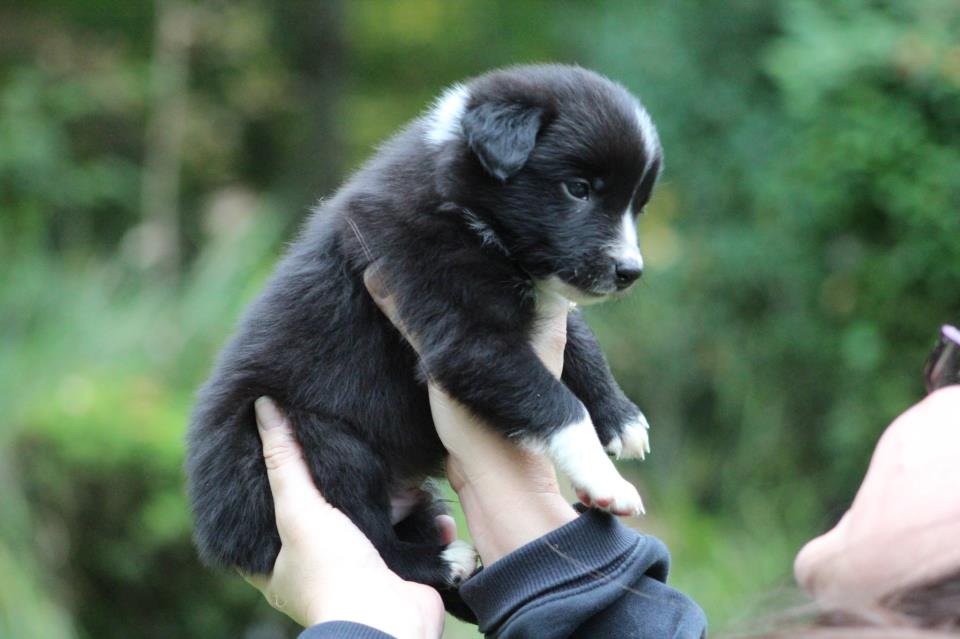
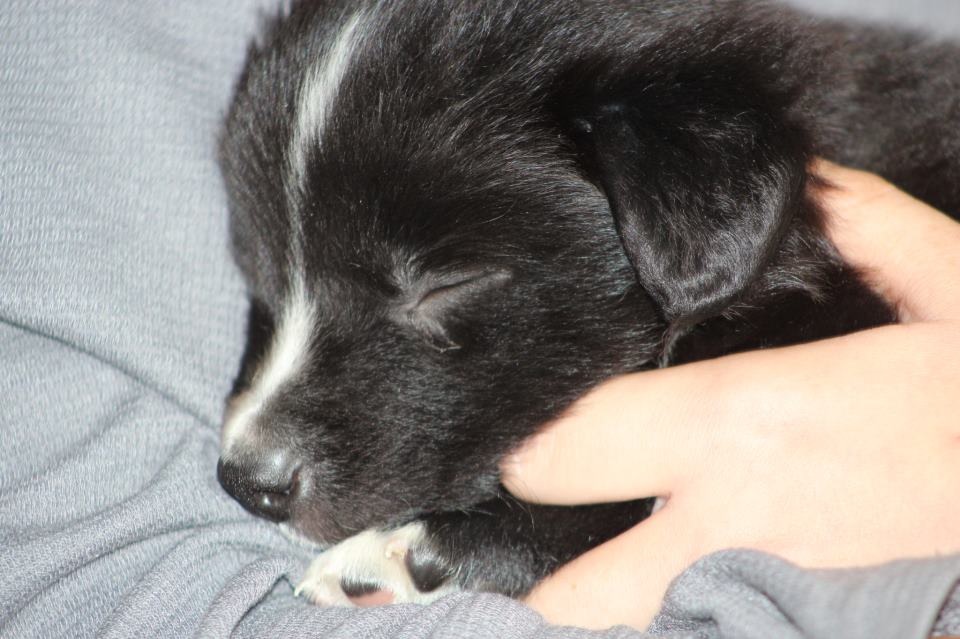
Wee at five weeks.

Wee at five weeks.

Now that the pups were home and settled again, life continued as before. The family all stepped up to offer extra support and care for Wee. It was also time to notify the seven families that the puppies would be ready to go in another month. I arranged a puppy visitation day for those who lived close enough to make the trip.

I wasn’t ready to promise Wee to anyone just yet.

Wee progressed, consistently a week behind his littermates. His vision and his gait improved. His gut tolerated the puppy mash well. To make sure his heart was developing normally, I took him to see a cardiologist, Dr. Goodwin. Obviously charmed by his tiny little patient, no bigger than two handfuls by now, he listened with his stethoscope. The chest piece nearly took up Wee’s entire underside. Next he hooked his tiny body up to an electrocardiograph machine. I watched the colorful waves go up and down all the while listening to the whoosh, whoosh of his heartbeat. Wee was the best patient, lying quietly in the technician’s arms. I had to remind myself to breathe, or I was liable to be the doctor’s next patient. Dr. Goodwin turned off the equipment, took Wee from the technician, held him in his arms so Wee was facing him. “Well little one,” he smiled, “You have the heart of a lion.”

“His heart sounds OK?” I said, remembering now to take a breath, as I wiped tears from my eyes.

“Yes, his heart is perfect.”

Wellness exams and first vaccines were still a few weeks away. I decided that I wouldn’t torment myself with “what if’s” and would just enjoy the time I had left with the pups. By now they were keeping the family and me busy with three feedings a day, taking them outdoors to learn to do their “good puppy” business, cleaning up, and giving them lots of hugs and kisses.

Wee and his new friend.

Wee and his new friend.

Soon enough puppy visitation day arrived. Luckily it was a gorgeous day, and the families and friends came to hold, hug, and love them. A little boy who scooped up Wee and wouldn’t let him go. Wee was perfectly content with his new friend. I must say, it was a beautiful sight. I beamed with delight watching Wee with his littermates enjoying all of the attention.

In the meantime I had gotten an email from someone looking for a dog. She went on to talk about her last dog that had since passed away. She felt she was ready for another. I was immediately drawn to her compassion and thoughtfulness. My only concern was that she lived in Colorado, and I wasn’t willing to ship a puppy in cargo. We exchanged phone numbers, and I gave her a call.

“I would love a Border Collie,” Wendy told me. “I’m an endurance athlete so an active dog would suit me.” We talked for a long time. I discussed some options with Wendy and then mentioned Wee.

“He must be adorable! Would you please send me some pictures?” Wendy said.

“Sure, I’ll send pictures, but I need you to know that I have had concerns about his development.” I couldn’t guarantee he’d develop normally. We decided I’d send pictures, and we’d wait to see how he continued to develop.

The day arrived for the pups to receive their first vaccines. I packed up the whole bunch and off we went to see Dr. Jeschke. One by one he weighed, examined, and vaccinated them.
“What do you think of Wee?” I asked.

“He looks good, other than the fact that he’s smaller than his littermates. If he doesn’t continue to grow, I’d like to rule out a liver shunt. We’d need to do some bloodwork and an ultrasound.”

My fears resurfaced. “Should we do it soon?”

“Not yet,” he smiled. “He’s all right for now. Don’t over think it.”

The next twenty-four hours I watched the puppies closely for any vaccine reactions, and they all did well, even Wee!

Megan's Brea and Ace

Megan’s Brea and Ace

The following weekend all the pups would be heading out on their new adventures with their families. As always, the day arrived sooner than later. The box of tissues was ready to roll! One by one, the families arrived, scooping up their chosen bundle of joy. I’d go over all of the appropriate information and paperwork and exchange hugs and puppy kisses as they made their way out the front door. Megan chose not just the firstborn black-and-white male but also a female that so closely resembled Wyn I could barely let her go. Normally I don’t recommend that someone take two puppies, but Megan and her husband Keith were up to the task. I would also be an intricate part of helping her raise the pups. I told her, “We’ll have joint custody,” and she laughed and hugged me.

In the meantime Wendy and I continued to correspond about Wee. By this time I was more at ease with his progress. The little stinker was doing great!

“I’d really like to adopt Wee,” Wendy wrote me. “I have a trip planned to PA. I’ll make arrangements to have him fly in coach with me. What do you say—can he come home to Colorado?”

“I’d be honored,” I replied. “What a lucky pup to live with you in Colorado.” So the arrangements were made for Wee to travel to with Wendy to become her long-distance running companion in the mountains of Colorado. The littlest pup was going on the biggest adventure!

Wee, Part 2

I Wish I Had a Crystal Ball

by Terri Florentino

echosailorpups1“These pups are gorgeous! What a beautiful and balanced litter–four males and four females,” my mom, Sandy, exclaimed while scooping up Wee pup. “This little guy is a fighter.”

He was awful small. He needed extra attention, more than I could give. “I’ll need your help,” I said.

She nuzzled Wee’s tiny nose. “You know how much I love taking care of the puppies.”

“He’s a bottom feeder,” I joked. “He makes his way along Echo’s underside to find a nipple. We need to keep watch all the time to stop the others from elbowing him away from the milk bar.”

photo 2My husband, my mom, my two daughters, and I arranged our schedules so someone was always there to rotate the puppies and make sure Wee was nursing. One of my shifts was two a.m. The first few nights, I’d lie awake and worry. Two a.m. just couldn’t come soon enough. Finally I’d get out of bed, make my way to the whelping area, peer into the box, and hold my breath until my gaze found little Wee and saw him move.

photo 3-1

Wyn and Wee.

Echo’s daughter, Wyn, was a big help too. Whenever Echo left the box to eat, drink, or stretch her legs in the yard,  Wyn climbed in, lay down, and licked and nuzzled the puppies. In fact, the puppies suckled on her so much, she started lactating. This phenomenon is perfectly normal, commonly found with packs of wolves. The pregnant female will select an assistant from among the other females to help her rear the puppies. Wyn was such a good second mom, I was able to let her have Wee all to herself. Thanks to her, Wee didn’t have to struggle to nourish himself, and she seemed blissful.

wee 1Once I stopped worrying that he might not make it through the day, I began to worry about Wee’s physical development. His littermates could drag themselves along by pulling with their front legs and pushing with their back. Wee could push along with his back legs, but he could not tuck his front legs underneath to pull himself forward. When you held him up he would extend his front legs out to his sides in a “splat,” position.  He might never be structurally sound enough to walk. Several times a day I’d force him to exercise his limbs, and the more I worked with him, the more I saw he wasn’t developing normally. He was going to need constant physical therapy.

“OK, girls, let me show you a few stretching and strengthening activities I’d like you to do with Wee a couple of times a day,”  I explained to my daughters, Amy and Heather.

“Not a problem,” Amy said.

“Do you think it will help him?” Heather asked.

“I’m not sure, but we have to try,” I said, and they were eager to help.

photo 5My second immediate worry was the shape of his head. It was dome-like, indicative of hydrocephalus, a condition in which the cerebrospinal fluid doesn’t drain properly, causing an apple-shaped head. Symptoms include loss of movement and coordination, depression, vision problems, and seizures.

I wished I had a crystal ball. Was Wee going to develop normally? Or would he only need more and more from us?  Would he suffer? I began to wonder if I was being fair to my family. By now we were all emotionally invested. What if Wee didn’t make it? How would I know if euthanasia was the humane thing? How would I break the news to them? I dreaded the thought of putting my family through the pain of losing the little guy.

I decided that as long as he progressed and wasn’t in pain, I’d continue to help him to carry on.

photo 2-1Every day I watched him tussle his way through his littermates to the “milk bar.” I tried to find the balance between normal puppy interaction and frustration. I didn’t want him to develop a “Napoleon” complex. Whenever I sensed him getting overly annoyed, I intervened and either moved him right up to a nipple or allowed him nurse peacefully alone with Wyn.

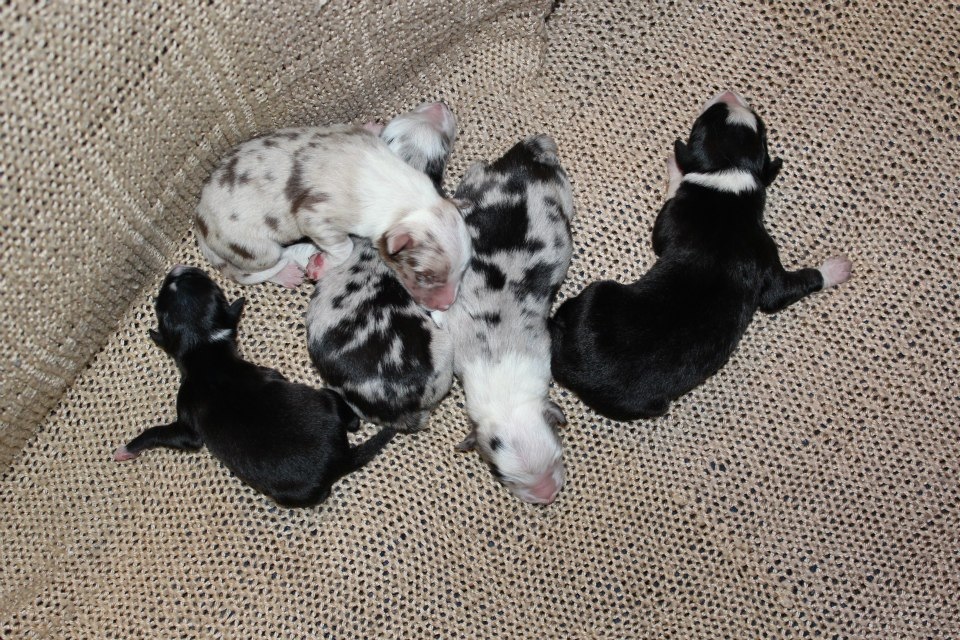
Once his belly was full, however, he wasn’t content unless he was curled up with his littermates in this puppy Jenga-like arrangement. They were so charming all cozy and coiled up together.

As the days passed, he continued to grow. His development seemed to be typically a week behind his littermates. His legs became stronger, and he developed the ability to tuck his front legs underneath in order to pull himself along.

At about fourteen days, his littermates’ eyes started to open. I didn’t see Wee’s little tiny black eyes until he was closer to twenty-one days old. I was concerned that he might never have normal vision.

photo 1When the puppies are at about three to four weeks, I introduce solid food. The food is puppy kibble soaked in water, giving it an oatmeal consistency. I make sure they always have more than enough food. I never want them to have to fight for it. Once they’ve eaten their hearts’ content, the puppies look like they just had a finger painting contest all over one another. Echo would take delight in finishing the uneaten portion and licking all her puppies clean. Early on in the feeding process, Wee needed to be separated to be fed. He wasn’t  coordinated enough to hold his head up to eat and swallow effectively. He sat in our laps while we held his head in position and let him lick the kibble off of our fingers. He loved these feeding sessions and ate so enthusiastically, we almost wished this sweet task would last forever.

When the pups were three weeks, my son was graduating from Navy basic training. I asked Megan if she would take care of Echo and the puppies while my family and I were out of town.  Since Megan worked as a veterinary surgical technician, I knew she’d make sure the puppies had everything they needed. She was also taking one of the puppies, so this opportunity would give her ample quality time with them. I left her with detailed instructions on how to care for the puppies, especially Wee.

“I know you will do great,” I said. “If anything goes wrong with Wee, I trust you will do the right thing.”

“I won’t make any decision unless I speak to you first,” she said.

photo 3The next morning my family and I packed up and headed out to Chicago. As I left Megan smiling down at the puppies and stroking them, I worried about her. Yet again, there was another person emotionally invested in our adorable little runt. I felt bad leaving Wee. He was so used to all of us tending  him, our smells and sights and ways of doing things. Would this stress him? I couldn’t help but wonder if he would perish while I was out of town.

Wee, Part 1

Wee’s First Hours

by Terri Florentino

“I think she’s having another puppy!”

“Another?!” My friend Megan had been helping me to whelp the litter the entire night. It had been two hours since Echo delivered her seventh and last puppy–suddenly she was bearing down and  licking again.

EchoSailorPI moved the other seven puppies to the far end of the box out of her way. While I assisted Echo, Megan got the hemostats, washcloth, bulb syringe, and scissors ready for yet another go. As we watched, Echo delivered what looked to be nothing more than a placenta.

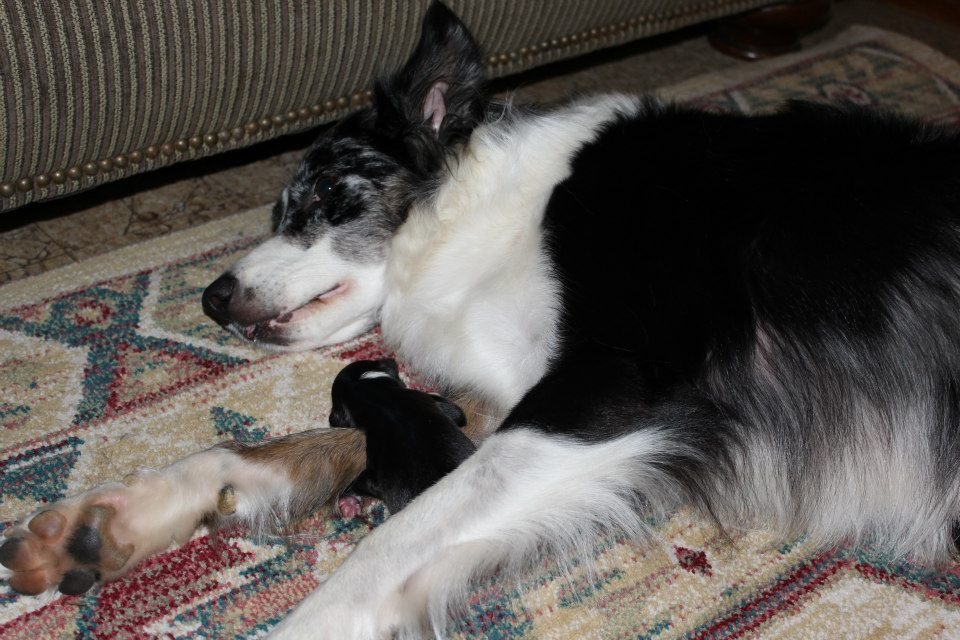
“No puppy,” I said. As my hand closed around the mass, I felt something inside the size of a mouse. “Megan, hand me a wash cloth and a bulb syringe! I think there’s puppy in here!” I removed a section of the sac away, and there was the smallest black and white face I’d ever seen. Megan and I shared a look of amazement and fear. Afraid the puppy wasn’t breathing, I placed a bulb syringe in its mouth to clear away any mucus and wiped its teensy nose. Once Echo had separated the puppy from the umbilical cord, I massaged him in a towel.

“Is he breathing?” Megan asked.

I opened the towel to look. I had never seen such a tiny Border Collie. He was half the size of his littermates. “He’s gasping—hand me the bulb syringe. I want to clear his mouth and nose again.” I gently massaged him with the towel and waited for a little cry.

wee 2By now Echo was nudging my hand, demanding her puppy like the good mother she was. I set him in the box between her front legs. She rolled him from side to side, washing him from the tip of his nose to the tip of his tail. She didn’t seem concerned about his size; she was as diligent with him as she was with his littermates. Surely she would have sensed if he was disastrously abnormal.

“His color looks good,” Megan said. We were both looking for whatever reassurance we could find. “He’s breathing  steady, right?”

“True,” I sighed, and sat back. “But I’d hoped to hear a little squeal out of him by now.”

echosailorpups1Once the pup was sufficiently washed, I leaned over the whelping box and moved him into position to nurse. Much to my delight, the little guy latched on and eagerly suckled. We began to relax, and fatigue set in.

“Let’s weigh them. After we’re done I’ll go wash Echo if you’ll freshen up the whelping box and put down the fleece.”

“You bet,” Megan said. All seven puppies weighed either fifteen or sixteen ounces. The wee one was eight. Megan recorded their weights. “He is literally half their size!” she said.

“C’mon Echo, let’s go for a walk,” I said. Echo jumped out of the box and ran out the door. Once back inside, I placed her in the bathtub for a quick rinse. Wyn, who is a daughter of Echo’s from a previous breeding, took over licking and fussing after the puppies while Megan was busy wiping down the whelping box and lining it with a large piece of soft, warm fleece. Echo never minded Wyn caring for the pups in her absence.

After Echo was dried and clean we returned to the puppies. Echo immediately jumped into the box and gingerly lay down with all of her puppies. The puppies were squirming and squeaking while making their way to the “breakfast bar.” I placed little wee puppy at the nipple closest to him and helped him latch on. Once latched, he eagerly nursed. Megan and I watched in dismay as the stronger puppies pushed him away from the “milk bar” as if he was nothing. It was going to take a lot of management to keep this puppy going. I wasn’t going to be able to do this alone. It’ll take a village, I thought.

wee 1My mind went a million different directions all at once; I’d never had a runt. I feared the little guy wouldn’t make it through the night. I tried to prepare myself for worst, but except for his size, he was vigorous. He was determined to survive. If the little guy was giving it his all, I would give him mine.

Dusty, Part 4

Love Him Wisely

by Terri Florentino

“The truth is,” Susan said. She paused and ran her hand over her mouth. She took a breath. “Dusty can be so volatile that I’m afraid of him.”

Susan, Robert, and Dusty

Susan, Robert, and Dusty

I tensed. “Sometimes there are hard deci—”

“No. I’m in this for the long haul. We all are.”

“Okay. Good,” I relaxed. “I’m going to need you to love him wisely.”

“Can do,” Susan said.

We agreed to check back frequently, and a week or so later I visited them to follow up after their trip to the vet. I heard happy yelling and scrabbling behind the door as Susan put Dusty behind the baby gate. She let me in smiling and breathless.

“You were right,” she said. “The doctor agreed medication would ease his stress and lower his aggression. He’s been on it a few days now.”

I moved deliberately and calmly, never looking directly at him. Behind the gate he sat cute as a button and watched me intently. “Have you noticed any differences yet?”

“I’d say he’s showing a little less a play drive, which is sad, but the good news is, he is definitely less reactive.” She led me into the kitchen. “Juice? Tea?”

The fur family.

The fur family.

I could hear the hope in her voice, and I smiled. “Don’t relax yet. We’ve just begun. Keep a leash on him at all times, indoors and out, day and night.” This way he if started to act inappropriately they could get control of him quickly. “Think of the leash as an umbilical cord. If you want your dog to learn from you, he needs to be attached to you.”

Robert met us in the kitchen looking more at ease than the last time I saw him. We shook hands.

“I was just saying, be aware of Dusty’s body language and watch for early signs of reactivity.”

“I know exactly what you mean,” Susan said. She put a kettle on the stove. “His body stiffens, his head drops, his eyes stare, and he might let out a low growl you can barely hear.”

“The second you see him enter that mode, change the subject.”

“Should I offer to take him for a walk or to get the ball?” Robert asked.

“Yes, and I’ll teach you to learn some constructive learning games in class,” I said and grinned. “You’ll have a whole repertoire of new subjects.”

Susan was setting three teacups and saucers on the counter. She turned and flashed me a big smile at the thought of Dusty having lots of fun things to do besides snap and growl.

It’s important to be pro-active rather than re-active. “Let’s not set him up to fail. For instance, he’s not sleeping in your bed anymore.” I took a seat at the kitchen table, and Robert joined me. “Since that last episode with you and the bed, Dusty has lost the privilege of sharing that space. Do you see what I mean?”

Susan set a box of herbal teas on the counter and turned around with a frown. “Where should he sleep?”

“In a crate, where you know exactly where he is and what he’s doing.”

“That won’t be a problem,” Robert said, relieved.

Susan set a plate of sugar cookies on the table and joined us. We discussed Dusty’s fear of people he didn’t know. “Don’t force the issue this early on. Once you and Dusty attend my classes we’ll work on promoting positive interaction.” The kettle whistled, and Susan got up. “In the meantime allow him to be social with people he’s relaxed with, but take him immediately out of any situation that makes him uncomfortable. Baby steps, okay?”

I explained the nothing-for-free concept. “Dusty needs to earn everything,” I said, as Susan filled my teacup. “Everything. Toys, food, treats, free time, and affection must be earned.”

Susan and Robert looked at each other, dipping their teabags. “This is going to be hard,” Robert said.

“It’s doable,” Susan said.

“It’s worth it,” I said. We raised our teacups. “To Dusty.”

It took years. They trained Dusty in basic obedience, rally, tricks, Beyond Backyard, and even Canine Good Citizen.

“One of the secrets,” Susan said in an email, was that “Dusty loved the hotdogs we used for training. It helped keep him focused on me. Each night the family and I also enjoyed practicing all of the skills we learned with Dusty, and it tired him out.”

Tigger, Autumn, and Dusty

Tigger, Autumn, and Dusty

Surprisingly Dusty was tolerant of other dogs. He didn’t want to wrestle and play with them, but he was comfortable in their presence. Susan and Robert eventually got two cats. “I never thought Dusty would get along with the cats, but I believe they helped with his social development. He and Tigger are good friends. Autumn tolerates him. It’s so funny seeing our tough guy get smacked around by a cat and tolerate it.”

“Dusty and I formed a strong bond during the training process. I had a blast training him, and he loved to learn. I was amazed at the transformation in Dusty once I stopped the punishment and intimidation technique I’d learned on television. I focused on his good qualities. Seeing the twinkle in his eye and overall happier demeanor motivated me to keep going. After I while, I wasn’t afraid of him anymore. I was more and more determined to save him. We were able to wean him off of the Prozac after only a year. It got easier and easier to love him. We became the best buddies I dreamed we would be.”

Dusty and the Kids

Dusty and the Kids

Susan and Robert did a remarkable job with Dusty. I had cautioned them that Dusty’s baseline personality would never completely change, so the behavior management techniques have to be lifelong habits, and they followed through. I’ve seen it too often: the biggest mistake that my clients make is falling back into their old habits with their dogs. When they fall back, the dog falls back, and the trouble’s back.

“I’m not afraid of him anymore,” Susan said. “But I’ll always be guarded in certain situations. He still gets annoyed. It’s clear he can never be trusted, just as Terri predicted. He still wants to be the boss, but we try to keep a nothing-for-free attitude with him. I recognize his triggers and immediately change the subject. He’s much easier to re-direct now, and he’ll forgive and forget quickly. He rarely sleeps with us, and when he does he’s on a leash, and Rob gets in bed first, then he is invited up. My mission is to make sure he stays on the right path.”

Dusty and his favorite person, Susan

Dusty and his favorite person, Susan

Some things haven’t changed. Susan is still his favorite person, and he’s protective of their daughter Sarah. He still keeps an eye on Robert. He’s an intelligent dog, so he was easy to train. He demands attention but he’s learned to ask for it playfully. He loves riding in the car, going to the beach or park, and seeing other dogs. “The best part,” Susan said, “besides being able to keep and develop a satisfying relationship with Dusty, was meeting the people along the way, who helped us.  Especially Terri, but we met others who truly cared about our plight, and understood the potential heartbreak and stress of what it was like to have to deal with him.”

Susan got choked up remembering the tough times. “So many of our friends and family said we should euthanize him.” She shook her head. “I never knew the depth of the relationships between man and dog, and how much a dog understands and feels. I learned about dog rescue, and saw people give of their time, money and emotions to protect the helpless lives of so many dogs.   How inspiring is that? I appreciate dogs more than ever, and even though Dusty will never be a therapy dog, I am inspired. I hope to have a Therapy Dog one day.  I never would have been exposed to that if it wasn’t for Dusty. This experience has been invaluable to me in many ways.”

“Now I realize the truth in Anatole France’s quote, Until one has loved an animal, a part of one’s soul remains unawakened.

Beach Dusty

Dusty, Part 3

Nature, Nurture, and Dusty

by Terri Florentino

“What exactly do you mean by, ‘pack mentality?’” I asked Susan.

Unhappy Dusty

“I’m not sure Dusty knows what fun is.”

Behind the baby gate, Dusty blinked at the three of us sitting around the dining room table, blowing our noses and deciding his fate.

“A take-charge attitude. I was the ‘Alpha,’ not Dusty.” Susan said she followed what she’d learned from the dog-training television show. “When Dusty would resource-guard something I’d try to intimidate him into releasing it. I’d get very close to him, use a sharp guttural tone and order him to, ‘Leave it!’”

“What happened?”

“Well,” she said with a rueful laugh, “that never worked, so I did like the expert said and picked him up and angled his head towards the floor. A few times this did work.  He’d drop it.” Before long, however, he began to threaten her with an uncompromising growl.

“He bit me,” Robert said. “Again and again. I’d only yank something away from him if I thought he had a hold of something dangerous. He broke my skin every time!”

Dusty had never been a social butterfly with strangers. His normal response was to walk away. As Dusty neared a year old, when people reached to pet him, he showed his teeth, growled and lunged.

"Sarah adores him."

“Sarah adores him.”

“Even though he’s gotten to be such an unpleasant, and even dangerous little character, I love him.” Susan paused to collect herself, and I thought she might need another tissue. “Our daughter Sarah adores him. He’s never gone after me or the kids.”

“He’d be gone,” Robert said. “In a heartbeat.”

Susan squeezed his hand. “Look, Dusty was supposed to be our pet. The family pet. It’s not fair for Rob to live in fear in his own home, terrorized by a fluff ball.”

We all glanced at the fluff ball. He hadn’t moved. I started to wonder if he wasn’t a stuffed toy. He sure was cute.

“Now that he’s trying to bite other people, we’re at our wit’s end. We just can’t live like this. We can’t live with a dangerous dog.” She had steeled herself. She wasn’t going to cry.

Not knowing where to turn, Susan emailed Dusty’s breeder with her concerns about his behavior. To her surprise, the breeder replied that she and her family must have harmed him and ruined him. She refused to take him back, under any circumstances. “If you can’t handle him, you’ll have to euthanize him.”

“Euthanasia was not an option. I could not kill my daughter’s dog.” Susan reached for the tissues. “I started to believe the breeder was right. I must have ruined Dusty.” Even though she’d been following all the techniques of the well known television trainer, she suspected she’d only made things worse.

“Once the vet did a physical and blood work on Dusty, and everything came back normal, she told us to call you. She said your experience and motivational approach would be our best option.”

“Let’s get started,” I said. I sighed and thought for a moment. Some things were hard to say. “The first thing I want you to understand is that a certain percentage of personality traits are inherited and indelible.” I turned to Susan. “Based on your description of Dusty’s behavior right from the start, I’m certain that some of what you are seeing is his genetic baseline personality.”

“So he was born this way? And he’s always going to be like this?” Susan teared up. “I’m sorry. This is just so sad.”

“No, no! Don’t apologize. Your heart is breaking. I get it. I’ve been there. And I’m not saying things can’t get better for Dusty. This goes back to the nature-versus-nurture debate. Nobody’s entirely sure how much of each influences personality. All we know for sure is that a certain percentage of both are factored into the final product.”

Susan balled the tissue in her fist and looked at her hands. “I should’ve done things differently. It never felt right. I ruined Dusty.”

“No. It is both nature and nurture, but you still can’t blame yourself. Look, a dog with Dusty’s issues has to be handled very carefully, and you couldn’t have known that. You did your best. You’re still doing your best, and that’s awesome.”

Susan and Robert nodded. They smiled.

"We need to lower his anxiety."

“We need to lower his anxiety.”

“Before we can teach him new skills, we need to lower his anxiety.” I recommended that they talk to their veterinarian about anxiety medication.

“You’re kidding me,” Susan said.

“That’s interesting,” Robert said. “I’d heard about it. People do it all the time. I just hadn’t thought of Dusty as anxious.”

“He’s afraid,” I said. “He was afraid before you met him.” I also explained what I refer to as, “the nothing for free concept.” This theory is based on controlling all resources. “Anything of value to your dog must be earned.” Into his daily routine we would integrate positive, reward-based motivational techniques. “All of this has to be fun, okay? Fun for you, fun for Dusty.” I turned toward the pup behind the gate and in my best, “Oh, boy!” voice I said,  “Right, Dusty?”

He slid to the floor and dropped his head on his paws with a grunt.

“Fun?” Robert said. “I’m not sure Dusty knows what fun is.”

I’d love that. I want him to enjoy his little life,” Susan said.

“Okay. We make him feel safe. We set him up for success,” I said. “Deal?”

We had a deal.

Dusty, Part 2

Dust Comes Home

by Terri Florentino

Winter Dusty'

“There was nothing normal about him.”

As Susan and Sarah followed the young lady into the house, Susan said, “I’d like to meet our puppy’s parents.”

“I’m sorry,” she said over her shoulder. “We don’t allow anyone to go to the area where the dogs are housed. You might bring germs in on your feet, and the dogs could get sick.” She looked back again, wrinkling her nose at Susan.

“Oh. Of course.” Susan had been hoping for a glimpse of how her pup would act and how he might look as an adult.

“You wait here,” the girl ordered. Then she turned to Sarah, grinned, and said with false gaiety, “I’ll be right back with your new puppy!”

As the young lady disappeared behind a door, Susan and Sarah beamed at each other. When the door opened again, they were breathless at the sight of the adorable ball of curly fur in her arms. Susan reached for the puppy. She hesitated. The puppy looked tense and pulled away from her. “Why does the puppy seem fearful? His tail’s not wagging.” Susan didn’t know how to feel or what to do. She had sent a non-refundable deposit and invested a five-hour drive for this puppy; turning back was not an option.

Nothing made him happy

“Nothing we did made him happy.”

“He’s just nervous, nothing to worry about, he’ll settle down.” The young lady kissed him on the head. He didn’t seem to mind that.

Gingerly, Susan took the rigid puppy and cradled him in her arms. Mechanically, the girl went over the contents of a basket of puppy food and other new-puppy essentials. By the time she was done, the puppy had relaxed. He even gave Susan a little kiss on her cheek. The affection offered her some relief. The fact that he was as cute as a button didn’t hurt either.

“Well, if you don’t have any more questions,” the girl said, in a way that invited no further questions, I’ll see you to your car.”

Susan hesitated; she felt full of questions, but couldn’t think of any in the face of such a brusque remark. “Well, we do have a long drive ahead.”

“Can I hold him? Can I hold him in the car?” Sarah said. “I can’t wait to show him his bed and his bowls and his toys!”

Out at the car, the pup went stiff with fear again as Susan opened the back door. She placed him in his new crate in the back seat, said goodbye to the strangely aloof girl, and headed on their way.

On the way home Sarah and Susan discussed what name they liked best for their puppy.  The pup was mostly white, with a small stripe of very light tan down his back, and some tan fur on his ears that looked like dust. Susan suggested calling him “Dusty.” Once the entire family arrived home later that evening they all sat around and discussed various names. Everyone liked “Dusty.”

Really sad Dusty

“He seemed depressed.”

“The first two weeks weren’t what we had expected,” Robert said.

“What exactly do you mean?” I asked.

“When they brought Dusty home, he seemed depressed,” he said. “Normally a puppy would run and play, but Dusty just lay around. I wondered if he was sick. I got down on the floor to wrestle with him, and all he did was sit and stare at me.”

“We were worried. I called the breeder,” Susan said. “She said Dusty just needed more time to adjust. Something didn’t seem right, so I took him to the vet, but she just assured me we had a healthy-looking puppy and that we needed to come back in a few weeks for some vaccines.”

Inevitably Dusty settled into some of what anyone would constitute as normal puppy behavior. He chewed on whatever met his mouth, got the usual puppy “zoomies—racing around and like he’d gone completely haywire, and started the puppyhood biting, or “mouthing.” The mouthing was so severe, they called him, “land shark.” Dusty grabbed and nibbled on hands, legs, pants, and feet. It was difficult to walk him; he got furious tethered to a leash and made every effort to chew through it to free himself.

"I wondered if he was resource-guarding me."

“I wondered if he was resource-guarding me.”

By the time Dusty was six months old he started to exhibit “resource-guarding behavior;” when he had food or a chewy, he growled and snapped dangerously at anyone who came near him.

“I was taking Dusty for a ride in the car,” Robert said. “He grabbed a tissue from the console between the seats, and I didn’t want him to swallow it. I reached to get it out of his mouth, and he grabbed my hand in his teeth—not just once, but again and again. He bit down as fast as he could, over and over, slicing me up. In the blink of an eye, there was blood everywhere!”

“I was devastated when Rob told me what Dusty did.” Susan got up and fetched a box of tissues. She dropped it on the dining room table and helped herself to one.

“Careful!” Robert joked. “Don’t let Dusty near it!”

“I didn’t dare admit it at the time,” Susan said, glancing at the button nose behind the baby gate. “But I simply could not enjoy my puppy.” She blew her nose. “How sad is that? He was never cuddly or affectionate. Nothing we did made him happy. There was nothing normal about him. He was bold, pushy, always had to have his way–or else! It was like he was terrorizing us. I had no idea what to do with such a mean and nasty puppy.” Susan began to cry again. “I couldn’t believe it. Who’s ever heard of such a thing?”

Robert squeezed her hand.

Susan pulled herself together. “It seemed like he was only putting up with me and the kids, but he outright hated Robert.” She laughed and sniffled. “I’m sorry, Honey.”

Robert smiled. “I know it’s true. I guess I didn’t smell right.”

“I understand how some dogs are intimidated by men who are authoritative and commanding,” she said. “But Robert is gentle and kind. He was sweet to him. He got down on the floor with him, talked in a high-pitched voice. He did everything right. He really tried. I thought maybe Dusty was resource-guarding the children and me from Robert.”

“When Dusty and I where home alone together, he was fine with me,” Robert said.

“That’s right,” Susan said. “When I was home, Dusty would never leave my side. When Robert came within a certain distance of me, Dusty growled until he backed away.

“Then he started trying to keep me out of certain rooms.”

“Okay, that’s interesting,” I said. “How did you each handle Dusty when he acted inappropriately?”

"He just seemed to tolerate the kids and me."

“It seemed like he was only putting up with me and the kids.”

“I’m embarrassed to say,” Susan said. “But there was this trainer I saw on television who emphasized the importance of being a pack leader. I followed his advice.”

“Okay, I see.” I looked at the angry little mop-head glaring at us from behind the baby gate. He had hardly moved a muscle the entire time. “I think we see where this is going, don’t we, Dusty?”

He didn’t even blink.